Start shopping and find your next favourite medicine.
Browse Catalog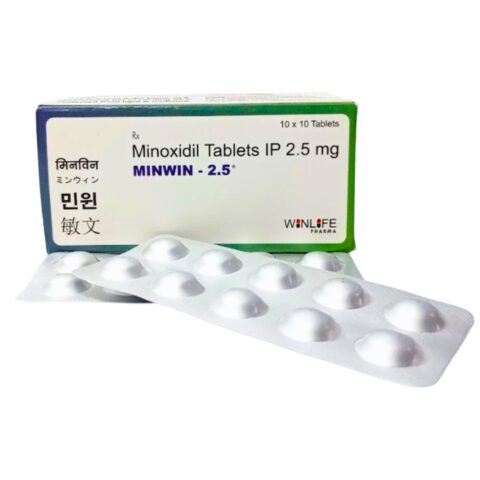
Minoxidil 2.5mg tablets have two distinct, prescription-only uses: as an FDA-approved antihypertensive for severe resistant hypertension, and as an off-label oral treatment for androgenetic alopecia (pattern hair loss) at low daily doses of 0.25mg–2.5mg. For hypertension, it’s prescribed alongside a diuretic and beta-blocker to manage fluid retention and reflex tachycardia. For hair loss, low-dose oral minoxidil (LDOM) has become a mainstream dermatology option, with safety data now available from a multicenter study of over 1,400 patients.
| Attribute | Details |
|---|---|
| Generic Name | Minoxidil |
| Drug Class | Direct vasodilator / antihypertensive |
| Brand Reference | Loniten 2.5mg (Pfizer); generic equivalents available |
| Approved Indication | Severe resistant hypertension (oral, FDA-approved) |
| Off-Label Use | Androgenetic alopecia (male and female pattern hair loss), low oral doses |
| Standard Hypertension Dose | 2.5–5mg twice daily, with a diuretic and beta-blocker |
| Off-Label Hair Loss Dose | 0.25mg–2.5mg once daily, dermatologist-titrated |
| Form / Route | Oral tablet |
| Prescription | Required in all markets |
Minoxidil opens ATP-sensitive potassium channels in vascular smooth muscle, causing vessels to relax and dilate — this is the mechanism behind both its blood-pressure-lowering effect and its hair-growth effect. On the scalp, the same vasodilation increases cutaneous blood flow and is believed to extend the anagen (growth) phase of the hair cycle, which is the proposed mechanism for its off-label use in pattern hair loss.
Low-dose oral minoxidil is now widely prescribed by dermatologists, but the evidence base is built mainly on open-label and retrospective studies rather than large placebo-controlled trials. A 24-week randomized trial comparing 0.25mg versus 1mg daily in women with pattern hair loss found both doses improved hair-shedding scores significantly from baseline, with no statistical difference between the two doses. A separate open-label study found 1mg oral minoxidil increased hair density by 12%, compared to 7.2% for topical 5% solution, again with no statistically significant difference between the two formulations. A large multicenter safety study has followed over 1,400 patients on low-dose oral minoxidil, which is the main reason it’s now considered a well-characterized option for hair loss management.
The most common side effect at low hair-loss doses is hypertrichosis (increased fine hair growth on the face or body), reported in roughly 15% of patients in the largest safety study to date.
At higher antihypertensive doses, fluid retention and reflex tachycardia are expected effects, which is why a diuretic and beta-blocker are co-prescribed.
At low doses (typically 0.25mg–2.5mg/day, well below the hypertension dose), oral minoxidil is an established off-label option for pattern hair loss, prescribed by dermatologists when topical minoxidil has failed or is poorly tolerated. Clinical evidence so far comes mainly from open-label and retrospective studies rather than large placebo-controlled trials, though safety data is now well documented across thousands of patients.
Topical minoxidil acts locally on the scalp with minimal systemic absorption, while oral minoxidil acts systemically and reaches all scalp regions at once, including areas hard to treat topically. Side effects like hypertrichosis are more common with oral use, though at low doses they’re generally mild and manageable.
Hypertrichosis is dose-dependent and more common at doses above 5mg/day; at the low doses used for hair loss (0.25mg–2.5mg), it affects roughly 15% of patients, usually as a mild increase in facial or body hair that often fades after a few months.
At antihypertensive doses, minoxidil causes significant fluid retention through compensatory aldosterone activation, so a diuretic (commonly furosemide) and a beta-blocker are prescribed alongside it to prevent fluid overload and reflex tachycardia. The low 2.5mg dose used for hair loss carries minimal fluid-retention risk and doesn’t require this co-prescription.
Yes. Oral minoxidil at any dose is prescription-only due to its cardiovascular effects, even though topical 2% minoxidil is available over the counter in many countries. A dermatologist or physician must prescribe and monitor oral use for hair loss in every market.
Store at 15–30°C, away from sunlight and moisture. Keep out of reach of children.
Medically reviewed. Last updated: [insert date]. This content is for informational purposes and does not replace consultation with a licensed physician.
Orders ship from our India Head Office within 1–2 business days of confirmation. We include full customs documentation — HS codes, certificates of origin, and pharmaceutical export permits.
Estimated delivery: 3–7 business days to UK. 7–10 business days to UAE, Saudi Arabia and Gulf countries. 10–15 days for USA and Asian countries.
All packages arrive in plain, unmarked brown boxes. No pharmacy name or medication details on the outside.

Reviews
There are no reviews yet