Q & A
Ask a question
There are no questions yet

Medically reviewed by a qualified oncologist | Last updated: April 2026 Prescription-only medicine | Administered by a qualified healthcare professional only | Mandatory biomarker testing required before use
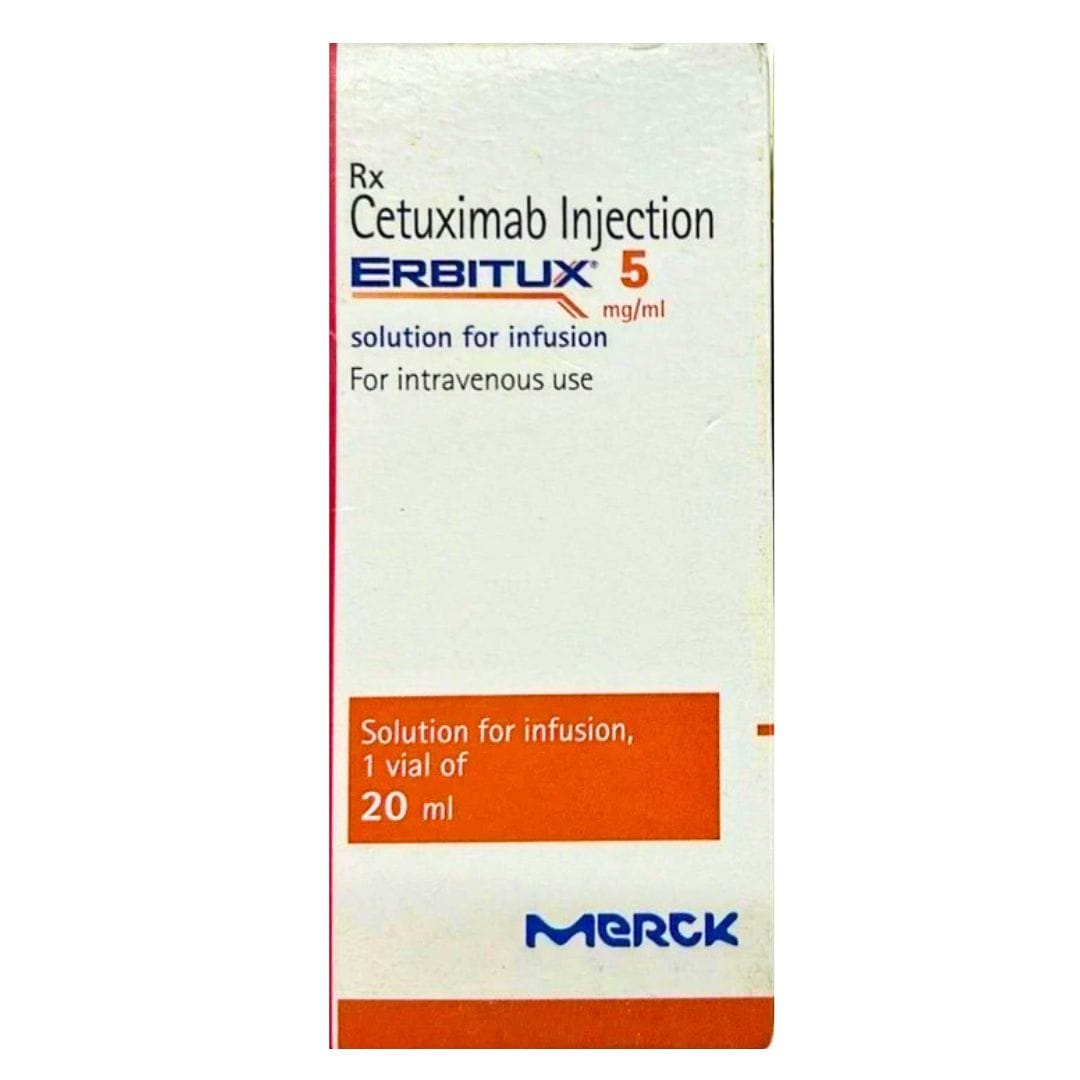
Erbitux 100mg Injection contains Cetuximab — a chimeric (mouse/human) IgG1 monoclonal antibody that specifically targets and inhibits the epidermal growth factor receptor (EGFR), a cell surface protein overexpressed in many solid tumours that drives cancer cell proliferation, survival, invasion, and metastasis.
Each vial of Erbitux 100mg contains cetuximab 100mg in 50mL solution (2 mg/mL) for intravenous infusion. A larger 200mg/100mL vial is also available. Erbitux is manufactured by Eli Lilly and Company (Indianapolis, Indiana, USA) for the US and Canadian markets. Outside the USA and Canada, Erbitux is commercialised by Merck KGaA (Darmstadt, Germany), with co-exclusive rights in Japan held by Merck, Bristol-Myers Squibb, and Eli Lilly.
Erbitux was first approved by the FDA on February 12, 2004 — making it one of the earliest approved EGFR inhibitor monoclonal antibodies in oncology. It has since become a foundational targeted therapy in colorectal and head and neck cancer, used across multiple lines of treatment and in combination with chemotherapy, radiation, and BRAF-targeted agents.
Key Facts at a Glance
Active substance: Cetuximab 2 mg/mL. Vial sizes: 100 mg/50 mL; 200 mg/100 mL. Form: Solution for intravenous infusion. Drug class: EGFR inhibitor (anti-EGFR monoclonal antibody). US manufacturer: Eli Lilly and Company, Indianapolis, IN, USA. International manufacturer: Merck KGaA, Darmstadt, Germany. FDA first approval: February 12, 2004. Storage: 2–8°C refrigerated. Do not freeze. Do not shake. Prescription: Required. Biomarker testing: Mandatory — RAS mutation status for mCRC; BRAF V600E mutation for BRAF-targeted combination use.
Erbitux enters 2025/2026 at the centre of the single most significant change in BRAF V600E metastatic colorectal cancer treatment in a decade — a paradigm defined by cetuximab's essential role as the EGFR inhibitor backbone in both established and newly approved BRAF-targeted combination regimens:
FDA Accelerated Approval — December 20, 2024: The FDA granted accelerated approval to encorafenib plus cetuximab plus mFOLFOX6 for the first-line treatment of patients with previously untreated metastatic colorectal cancer harbouring a BRAF V600E mutation, as detected by an FDA-approved test. This landmark approval — based on BREAKWATER trial data — expanded BRAF-targeted therapy with cetuximab from the post-progression setting into the first-line standard of care for this biologically aggressive subset. This is the most impactful new Erbitux approval since its 2004 initial clearance.
NCCN Colon Cancer Guidelines Version 4.2025 and 5.2025: Following the BREAKWATER trial data presented at the 2025 ASCO GI Symposium, NCCN updated its guidelines to include encorafenib plus cetuximab plus FOLFOX as Category 2A initial intensive therapy and Category 2B second-line and subsequent biomarker-directed therapy for BRAF V600E-mutant metastatic colorectal cancer (MSS/mismatch repair proficient). This positions cetuximab as the EGFR backbone across all lines of therapy in this mutation-defined population.
BREAKWATER 2026 ASCO GI Data: Cohort 3 data from the phase 3 BREAKWATER study, presented at the 2026 ASCO GI Symposium (January 2026), demonstrated that encorafenib plus cetuximab plus FOLFIRI provided significant objective response rate benefits versus FOLFIRI with or without bevacizumab, with a trend for improved overall survival — establishing EC plus FOLFIRI as a potential additional frontline standard of care for BRAF V600E mCRC.
No Erbitux biosimilar exists as of 2025: Cetuximab remains the only approved EGFR inhibitor monoclonal antibody without a biosimilar competitor — making Erbitux the sole branded cetuximab product globally. This exclusivity positions Erbitux as the reference standard for all cetuximab-containing regimens in current guidelines.
Erbitux is indicated for the treatment of K-Ras wild-type, EGFR-expressing, metastatic colorectal cancer, as determined by an FDA-approved test. RAS (including KRAS and NRAS) mutation status must be confirmed as wild-type before initiating Erbitux — patients with RAS-mutant tumours do not benefit from cetuximab therapy and should not receive it.
In RAS wild-type metastatic colorectal cancer, Erbitux may be used in multiple settings as endorsed by NCCN and ESMO guidelines:
In combination with FOLFIRI or FOLFOX as first-line treatment for RAS wild-type, left-sided metastatic colorectal cancer — one of the most clinically effective first-line regimens in this biomarker-selected population, achieving response rates exceeding 60% and significantly reducing the risk of disease progression compared to chemotherapy alone.
In combination with irinotecan for patients who are refractory to irinotecan-based chemotherapy alone — one of the original pivotal cetuximab indications.
As monotherapy for patients with EGFR-expressing mCRC who have failed oxaliplatin- and irinotecan-based regimens and who are intolerant of irinotecan — established by BOND trial data.
Erbitux is the EGFR inhibitor backbone in two FDA-approved regimens specifically for BRAF V600E-mutant metastatic colorectal cancer — a distinct and biologically aggressive subtype representing approximately 8–10% of all colorectal cancers, with right-sided tumour predominance, poor prognosis on standard chemotherapy, and median overall survival of under 6 months on FOLFIRI alone:
Encorafenib plus Erbitux (doublet — BEACON-established): FDA-approved April 8, 2020 for BRAF V600E mCRC following progression after prior therapy. BEACON CRC trial data showed median OS of 9.3 months with encorafenib plus cetuximab versus 5.9 months for standard chemotherapy. NCCN Guidelines Version 4.2025 recommend this doublet across second-line and subsequent lines.
Encorafenib plus Erbitux plus mFOLFOX6 (triplet — BREAKWATER-established): FDA accelerated approval December 20, 2024 for previously untreated BRAF V600E mCRC. NCCN Category 2A initial intensive therapy recommendation. This first-line triplet regimen represents the most significant practice change in BRAF V600E colorectal cancer management since the BEACON trial and places Erbitux at the centre of the new first-line standard for this patient population.
Encorafenib plus binimetinib plus Erbitux (triplet): NCCN Category 2A recommendation for BRAF V600E mCRC after 1 or 2 prior therapies. BEACON CRC trial showed near-doubling of median OS in the triplet versus chemotherapy control.
Erbitux is indicated in combination with radiation therapy for the initial treatment of locally or regionally advanced squamous cell carcinoma of the head and neck (SCCHN). The landmark BONNER trial demonstrated that adding Erbitux to radiation therapy significantly improved locoregional control and overall survival compared to radiation alone — without increasing the radiation-associated mucositis burden — establishing cetuximab plus radiation as a curative-intent alternative to cisplatin-based chemoradiation in patients who cannot tolerate platinum chemotherapy.
Erbitux is indicated in combination with platinum-based therapy with fluorouracil (EXTREME regimen: cetuximab plus cisplatin or carboplatin plus 5-FU) for the first-line treatment of patients with recurrent locoregional or metastatic squamous cell carcinoma of the head and neck. The EXTREME trial demonstrated a significant improvement in overall survival with the addition of cetuximab to platinum-fluorouracil doublet chemotherapy — 10.1 months versus 7.4 months — establishing Erbitux as a standard component of first-line recurrent/metastatic SCCHN therapy.
Erbitux is indicated as a single agent for the treatment of patients with recurrent or metastatic squamous cell carcinoma of the head and neck for whom prior platinum-based therapy has failed. This monotherapy indication provides a clinically proven treatment option in this difficult post-platinum population where few active agents exist.
Epidermal growth factor receptor (EGFR) is a transmembrane receptor tyrosine kinase that, when activated by its natural ligands (EGF, TGF-α), triggers downstream signalling cascades — RAS-RAF-MEK-ERK (proliferation and survival), PI3K-AKT-mTOR (survival and apoptosis resistance), and STAT3 (transcription and cell cycling) — that collectively drive cancer cell growth, survival, resistance to apoptosis, angiogenesis, and metastatic invasion. EGFR is overexpressed or aberrantly activated in the majority of colorectal cancers and nearly all squamous cell carcinomas of the head and neck.
Cetuximab in Erbitux is a chimeric IgG1 monoclonal antibody that binds with high affinity and specificity to the extracellular domain III of EGFR, competing with natural EGFR ligands. This binding achieves two complementary therapeutic effects:
Competitive antagonism of ligand binding: Cetuximab's binding to EGFR directly prevents EGF and TGF-α from activating the receptor — blocking all downstream oncogenic signalling driven by EGFR activation. This effect is direct and receptor-specific.
Receptor internalisation and downregulation: Cetuximab-bound EGFR is internalised and degraded, reducing total cell surface EGFR expression and blunting the cancer cell's ability to recover signalling capacity.
Immune-mediated tumour killing (ADCC): Cetuximab's IgG1 Fc region recruits natural killer cells and macrophages through Fc receptor engagement, triggering antibody-dependent cell-mediated cytotoxicity (ADCC) against EGFR-expressing cancer cells — an additional anti-tumour mechanism that distinguishes cetuximab from small-molecule EGFR inhibitors.
Why RAS mutation status is determinative: In tumours harbouring activating mutations in RAS genes (KRAS or NRAS — occurring in approximately 40–50% of colorectal cancers), the RAS-RAF-MEK-ERK signalling pathway is constitutively activated downstream of EGFR — regardless of whether EGFR itself is blocked. In these patients, cetuximab cannot suppress the driving oncogenic signal, and the drug is ineffective. RAS wild-type status is therefore a prerequisite — not merely a preference — for Erbitux use in mCRC.
Why BRAF V600E tumours require BRAF co-targeting: In BRAF V600E-mutant colorectal cancers, EGFR inhibition with cetuximab alone produces very limited benefit because BRAF V600E drives constitutive downstream MEK-ERK signalling that initially bypasses EGFR blockade. However, cetuximab combined with BRAF inhibitor encorafenib achieves simultaneous upstream (EGFR) and direct (BRAF V600E) pathway suppression — overcoming the feedback resistance mechanism and producing clinically meaningful response rates and overall survival benefit.
Pharmacokinetics: Cetuximab exhibits non-linear pharmacokinetics due to EGFR target-mediated drug disposition. Mean elimination half-life is approximately 110 hours (range 69–188 hours) — enabling once-weekly or every-two-week dosing. Steady-state is typically achieved by the third weekly infusion.
RAS (KRAS and NRAS) Mutation Testing — Mandatory for mCRC: Erbitux is indicated only for RAS wild-type metastatic colorectal cancer. Full RAS testing (KRAS exons 2, 3, 4; NRAS exons 2, 3, 4) must be performed using a validated FDA-approved assay before initiating Erbitux in any colorectal cancer patient. Patients with any RAS mutation — in either KRAS or NRAS — must not receive Erbitux.
BRAF V600E Testing — Required for Encorafenib Combination: Detection of a BRAF V600E mutation by an FDA-approved test is required before prescribing encorafenib plus Erbitux or encorafenib plus Erbitux plus mFOLFOX6. Encorafenib is not indicated for RAS wild-type BRAF wild-type colorectal cancer — it is specifically restricted to BRAF V600E-mutant disease.
EGFR Expression Testing — Required for mCRC Monotherapy Indication: EGFR expression by immunohistochemistry (IHC) is required to establish eligibility for Erbitux monotherapy in mCRC.
Tumour testing note: Erbitux is not indicated for the treatment of RAS-mutant colorectal cancer or when RAS mutation results are unknown.
Erbitux is administered only by a qualified oncologist or trained healthcare professional in a clinical or hospital setting with resuscitation capability immediately available. Never self-administer.
Mandatory premedication: Administer an H1 antagonist (e.g., diphenhydramine 50 mg) IV 30–60 minutes before the first dose. Administer premedication before subsequent doses based on clinical judgement and prior infusion reaction history.
Preparation: Do not shake or dilute Erbitux. Inspect for particulates and discolouration before use. Administer using a low protein-binding 0.22-micrometre in-line filter. Flush the line with 0.9% sodium chloride at the end of infusion.
Weekly Regimen (Standard):
Initial loading dose: 400 mg/m² IV over 120 minutes (maximum infusion rate 10 mg/minute). Do not exceed 10 mg/min infusion rate. Subsequent weekly doses: 250 mg/m² IV over 60 minutes. Continue until disease progression or unacceptable toxicity.
Every-Two-Week Regimen (Bi-Weekly):
For use in specific combination regimens (including FOLFOX or FOLFIRI combinations): 500 mg/m² IV every 2 weeks over 120 minutes. This regimen is used in combination with encorafenib plus mFOLFOX6 in the BREAKWATER-approved first-line BRAF V600E setting.
Head and Neck Cancer — Radiation Combination: Erbitux 400 mg/m² loading dose 1 week prior to initiation of radiation therapy, then 250 mg/m² weekly for the duration of radiation (6–7 weeks). Complete cetuximab infusion 1 hour before radiation session.
Head and Neck Cancer — Platinum-Fluorouracil Combination (EXTREME): 400 mg/m² loading dose on day 1 of cycle 1, then 250 mg/m² weekly throughout the treatment period.
Observation period: Observe patients for 1 hour after each infusion. Longer observation is warranted in patients who have experienced prior infusion reactions.
Dose modifications for infusion reactions: Grade 1–2 infusion reaction: Reduce infusion rate by 50% and continue. Grade 3–4 infusion reaction: Immediately and permanently discontinue Erbitux.
Dose modifications for skin toxicity: First occurrence of Grade 3–4 acneiform rash: Delay infusion 1–2 weeks; if improved to Grade 2 or lower, resume at 250 mg/m². Second occurrence: Delay and resume at 200 mg/m². Third occurrence: Delay and resume at 150 mg/m². Fourth occurrence: Permanently discontinue.
Dose modifications for pulmonary toxicity: If interstitial lung disease (ILD) is suspected, interrupt Erbitux immediately. If ILD is confirmed or does not improve within 2 weeks, permanently discontinue.
No dose modification required for renal or hepatic impairment — Erbitux is not renally or hepatically cleared in the conventional sense.
Erbitux is contraindicated in: patients with known RAS-mutant metastatic colorectal cancer or whose RAS mutation status is unknown; patients with a known severe hypersensitivity reaction to cetuximab; patients with Grade 3–4 infusion reactions to a prior cetuximab dose.
Use under close specialist supervision in: patients with a history of tick bites, red meat allergy, or documented alpha-gal (galactose-α-1,3-galactose) IgE antibodies — these patients are at significantly elevated risk of severe hypersensitivity reactions to cetuximab; patients with coronary artery disease, congestive heart failure, or arrhythmias — cardiopulmonary arrest has been reported; patients with pre-existing hypomagnesaemia; patients with pre-existing pulmonary disease; elderly patients.
Erbitux is not indicated in children or adolescents below 18 years of age. There is no data on use in pregnancy — Erbitux has the potential to cause foetal harm. Effective contraception should be used during treatment and for 2 months after the last dose.
Serious and Fatal Infusion-Related Reactions: Severe and sometimes fatal hypersensitivity infusion reactions have been reported with Erbitux. Approximately 90% of severe allergic reactions occur with the first infusion — even in patients who have been premedicated with antihistamines. Approximately 2–3% of patients in clinical trials experienced severe infusion reactions. Symptoms include bronchospasm, stridor, hoarseness, urticaria, hypotension, loss of consciousness, and anaphylactic shock.
Patients with a history of tick bites, red meat allergy, or detectable serum IgE antibodies against galactose-α-1,3-galactose (alpha-gal) are at significantly elevated risk of severe cetuximab infusion reactions. Enquire about tick bite history and consider alpha-gal IgE testing in patients from regions where tick exposure is prevalent (including parts of the southeastern USA, central Europe, and Scandinavia). Emergency resuscitation equipment must be immediately available throughout every infusion. Permanently discontinue Erbitux for Grade 3–4 infusion reactions.
Cardiopulmonary Arrest: Cardiopulmonary arrest or sudden death occurred in 2% (4/208) of patients with squamous cell carcinoma of the head and neck receiving Erbitux concurrently with radiation therapy in pivotal clinical trials. Monitor serum electrolytes — including magnesium, potassium, and calcium — during and after every Erbitux infusion, as electrolyte derangements (especially hypomagnesaemia) increase arrhythmia risk. Correct electrolyte abnormalities before and during therapy.
Hypomagnesaemia: Erbitux causes hypomagnesaemia in approximately 55% of patients — including Grade 3–4 hypomagnesaemia in 6–17% of patients. Hypomagnesaemia typically occurs during therapy but may persist for up to 8 weeks following the final infusion. Monitor serum magnesium, calcium, and potassium before each infusion and for at least 8 weeks after completing treatment. Supplement magnesium proactively in patients developing hypomagnesaemia.
Dermatologic Toxicity: Acneiform rash and other skin reactions occur in approximately 80–90% of patients receiving Erbitux — the most common overall adverse effect. Acneiform rash typically appears on the face, upper chest, and back within the first 2 weeks of treatment and correlates inversely with survival in some studies. Grade 3–4 skin reactions occur in approximately 15–20% of patients. Manage with topical antibiotics, topical retinoids, oral tetracyclines (doxycycline 100 mg twice daily is standard prophylaxis), and dose modifications as per the dermatologic toxicity algorithm.
Pulmonary Toxicity: Interstitial lung disease (ILD), including fatal cases, has been reported with Erbitux. Interrupt Erbitux immediately if ILD is suspected. Discontinue permanently if ILD is confirmed.
Not for RAS-Mutant CRC: Erbitux must not be used in patients with RAS-mutant colorectal cancer — no clinical benefit has been demonstrated and potential harm from unnecessary toxicity exists.
Radiation therapy: Combination with Erbitux in locally advanced SCCHN is the standard use — expect increased skin radiation reactions (acute radiodermatitis) in the radiation field, which may be more severe than radiation alone. Monitor skin toxicity closely.
Platinum-based chemotherapy (cisplatin, carboplatin) and fluorouracil: Standard combination partners in SCCHN and mCRC. Concurrent use increases the risk of hypomagnesaemia, nephrotoxicity (with cisplatin), and myelosuppression. Monitor electrolytes, renal function, and full blood count regularly.
Irinotecan: Standard combination partner in mCRC (FOLFIRI plus Erbitux). No clinically significant pharmacokinetic interaction between cetuximab and irinotecan. However, irinotecan exposure may be modestly reduced when combined with encorafenib due to CYP3A-mediated interaction — as noted in BREAKWATER safety lead-in data.
Encorafenib (Braftovi): The approved BRAF inhibitor combination partner. When combined with cetuximab in BRAF V600E mCRC, monitor for combined toxicities including skin reactions, GI toxicity, hepatotoxicity, and fatigue. Encorafenib inhibits CYP3A4 and may affect irinotecan exposure in FOLFIRI combinations.
Bevacizumab: Combination of cetuximab with bevacizumab in mCRC is not recommended — randomised trial data (COIN, NORDIC) showed no benefit or potential harm from this combination in unselected patients.
No formal drug interaction studies specific to Erbitux: Interaction data are based on clinical trial co-administration records and pharmacokinetic monitoring.
Very common: Acneiform (acne-like) rash on the face, upper chest, and back — occurring in 80–90% of patients, Grade 3–4 in approximately 15–20%. Hypomagnesaemia — occurring in approximately 55% of patients. Fatigue, nausea, diarrhoea, abdominal pain, and constipation. Fever. Headache. Infections (skin, respiratory tract).
Common: Infusion-related reactions — mild to moderate in most patients (Grade 1–2: fever, chills, rigors, urticaria, pruritus, dyspnoea). Skin dryness, fissuring, and paronychia (nail bed infections). Stomatitis and mucositis. Hypocalcaemia and hypokalaemia secondary to hypomagnesaemia. Weight loss. Conjunctivitis.
Serious — seek immediate medical attention for: Severe infusion reaction symptoms — difficulty breathing, throat tightening, wheeze, low blood pressure, loss of consciousness (anaphylaxis — permanently discontinue). Severe Grade 3–4 acneiform rash with superimposed infection or ulceration. Signs of cardiopulmonary compromise — chest pain, arrhythmia, sudden dyspnoea (risk of cardiopulmonary arrest, particularly in SCCHN patients receiving concurrent radiation or platinum-fluorouracil). Muscle cramps, tetany, seizure, or cardiac arrhythmia (signs of severe hypomagnesaemia). New-onset breathlessness or worsening respiratory symptoms (possible ILD).
Monitoring throughout therapy: Serum magnesium, calcium, potassium — before each infusion and for 8 weeks after completing treatment. Full blood count. Liver function tests. Skin condition assessment at each consultation — photographs recommended for rash monitoring. Infusion vital signs monitoring for minimum 1 hour post-infusion.
Store at 2–8°C in a refrigerator. Do not freeze. Do not shake. Protect from light. Erbitux should not be diluted before use. Prepared infusion solutions in 0.9% sodium chloride or 5% dextrose are stable for 12 hours at room temperature and 24 hours refrigerated — use within these time limits. Discard any unused portion of the vial — Erbitux contains no antimicrobial preservative. Dispose of unused medicine as cytotoxic biological waste in accordance with local regulations.
What is Erbitux 100mg used for? Erbitux is used for RAS wild-type metastatic colorectal cancer, BRAF V600E-mutant metastatic colorectal cancer in combination with encorafenib with or without FOLFOX/FOLFIRI, and squamous cell carcinoma of the head and neck — in combination with radiation therapy, with platinum-fluorouracil chemotherapy, or as monotherapy after platinum failure.
Is Erbitux used for all colorectal cancers? No. Erbitux is only indicated and effective in patients with RAS wild-type (KRAS and NRAS wild-type) colorectal cancer. Patients with any RAS mutation — present in approximately 40–50% of colorectal cancers — do not benefit from cetuximab and must not receive it. In BRAF V600E-mutant colorectal cancer, cetuximab must be combined with encorafenib.
What is the BREAKWATER trial and why does it matter? BREAKWATER is a Phase 3 trial evaluating encorafenib plus cetuximab-based regimens in first-line BRAF V600E metastatic colorectal cancer. The FDA granted accelerated approval in December 2024 for encorafenib plus cetuximab plus mFOLFOX6 based on BREAKWATER data — expanding BRAF-targeted therapy with cetuximab from post-progression into the first-line setting for the first time.
What testing is required before receiving Erbitux? RAS mutation testing (KRAS exons 2, 3, 4; NRAS exons 2, 3, 4) is mandatory for all mCRC patients. Erbitux must not be used if any RAS mutation is found. BRAF V600E testing is required if prescribing the encorafenib-cetuximab combination. EGFR expression testing is required for mCRC monotherapy.
Why does Erbitux cause skin rash? Acneiform rash occurs because EGFR is also expressed in normal skin keratinocytes — cetuximab inhibits EGFR in both cancer cells and skin cells, disrupting normal epidermal differentiation. Paradoxically, the presence of moderate-to-severe rash has been associated with better tumour response and survival in some studies. Proactive management with oral doxycycline 100 mg twice daily reduces rash severity.
What is the alpha-gal hypersensitivity risk with Erbitux? Patients with IgE antibodies against galactose-α-1,3-galactose (alpha-gal) — typically acquired from tick bites or associated with red meat allergy — are at significantly elevated risk of severe Grade 3–4 hypersensitivity infusion reactions to cetuximab. This risk is higher in the southeastern USA and parts of central Europe. Enquire about tick bite history before prescribing. Consider alpha-gal IgE antibody testing in high-risk patients.
Is there a biosimilar of Erbitux available? No. As of 2025/2026, there are no approved biosimilars of cetuximab (Erbitux) available in any market. Erbitux remains the sole branded cetuximab product globally.
Do you ship Erbitux 100mg internationally? Yes — discreet, secure shipping to USA, UK, UAE (Dubai, Abu Dhabi), Canada, Japan, Russia, China, Thailand, India, Saudi Arabia, and Australia.
Is a prescription required? Yes. Erbitux 100mg is a prescription-only oncology medicine. Always consult a qualified oncologist before starting, adjusting, or stopping cetuximab therapy.