Q & A
Ask a question
There are no questions yet

Reviewed by a qualified oncologist | Last updated: April 2026 Prescription-only cytotoxic medicine | Oncologist supervision mandatory | Handle with protective gloves
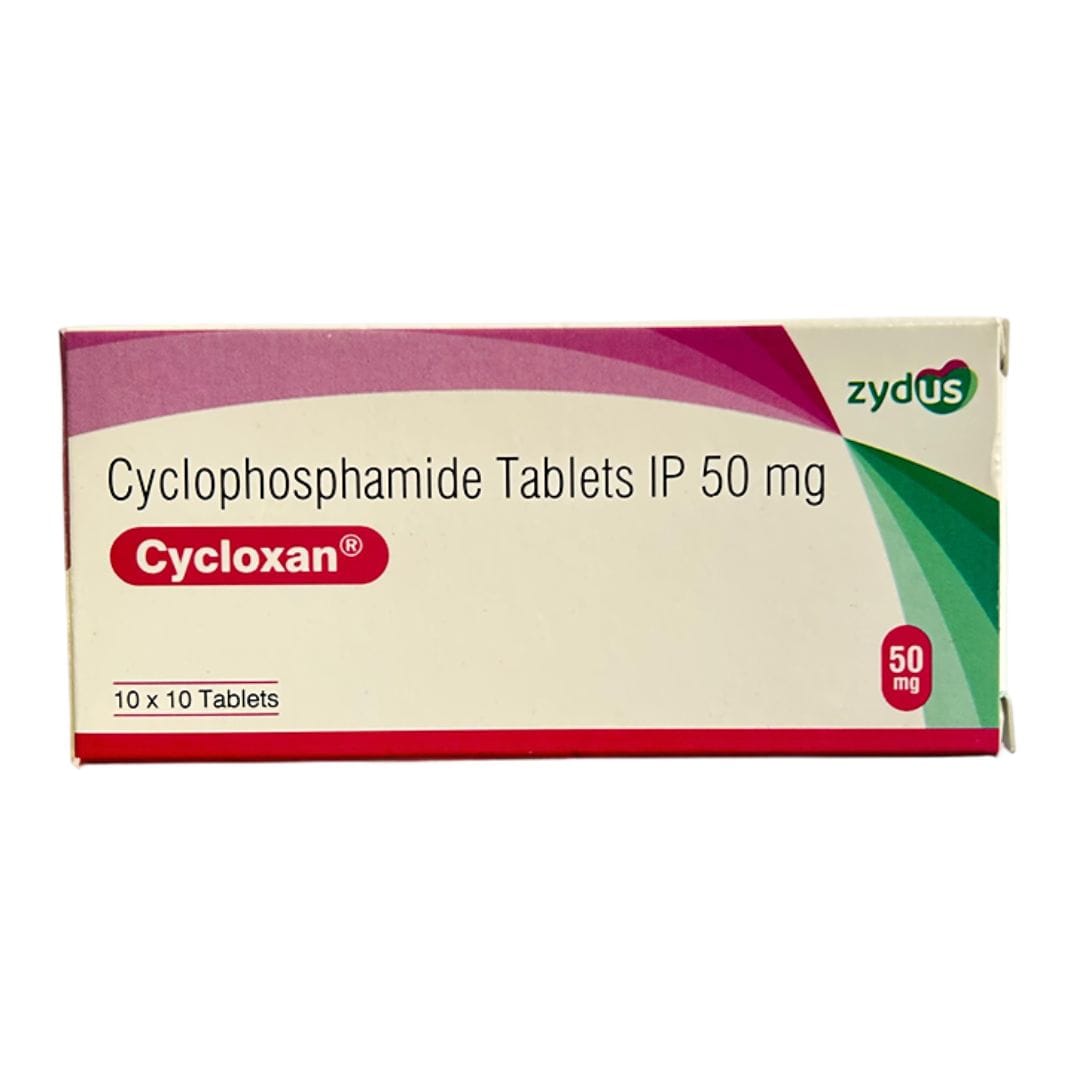
Cyclophosphamide 100mg is an oral alkylating agent — one of the oldest, most clinically versatile, and most widely used cytotoxic medicines in oncology and immunology. It is the active molecule in branded Endoxan® (Zydus Lifesciences/Baxter — India and global), Cytoxan® (Bristol Myers Squibb — USA), and Neosar (USA).
Available Indian brands at 100mg include: Endoxan 100mg (Zydus Lifesciences), Cycloxan 100mg (Zydus), and multiple generic manufacturers. The 100mg oral strength is specifically important because it enables metronomic chemotherapy — continuous low-dose oral administration that cannot be replicated with IV pulse therapy.
First approved in 1959, cyclophosphamide remains a Category 1 or Category 2A component in over 15 NCCN cancer guidelines and an essential medicine in multiple autoimmune and transplant protocols. It is on the WHO List of Essential Medicines.
The 100mg oral tablet serves a distinct clinical purpose from IV cyclophosphamide formulations:
Metronomic chemotherapy: Daily low-dose oral cyclophosphamide (50–100mg/day) produces anti-angiogenic and immunomodulatory effects beyond direct cytotoxicity — inhibiting tumour blood vessel formation and regulatory T cells. This approach is used in metronomic breast cancer regimens (cyclophosphamide + capecitabine or methotrexate) as an accessible, well-tolerated option for patients with metastatic or heavily pretreated disease.
Oral maintenance after IV induction: In lymphoma, lupus nephritis, and vasculitis, IV pulse cyclophosphamide induces remission — then oral tablets maintain it at lower cumulative doses, reducing toxicity.
Outpatient management: Oral tablets allow fully outpatient treatment without IV access, hospital admission, or infusion centre dependency.
| Indication | Role | Protocol |
|---|---|---|
| Breast cancer (metastatic) | Metronomic regimen | 50–100mg/day oral continuous |
| Non-Hodgkin Lymphoma | CHOP/R-CHOP component | 750 mg/m² IV or oral equivalent |
| Hodgkin Lymphoma | BEACOPP component | Per cycle |
| Ovarian cancer | CAP/CP regimen | Per cycle |
| Multiple myeloma | MP/VMP regimen | Oral maintenance |
| Lupus nephritis | Induction + maintenance | NIH high-dose or EuroLupus low-dose |
| ANCA vasculitis (GPA/MPA) | Induction of remission | 2 mg/kg/day oral or IV pulse |
| Nephrotic syndrome (children) | Steroid-dependent/resistant | 2–3 mg/kg/day × 8–12 weeks |
| GvHD prevention | Pre-transplant conditioning | High-dose protocol |
| Breast cancer (early/adjuvant) | CMF or AC regimen | 600 mg/m² IV or oral component |
Metronomic breast cancer note: The oral capecitabine + cyclophosphamide FDC (Comcapsy® by Intas) confirms the clinical importance of low-dose oral cyclophosphamide in this setting — its synergistic enhancement of capecitabine-to-5-FU conversion makes the combination more than additive.
Cyclophosphamide is a prodrug — inactive until metabolised by hepatic CYP2B6 enzymes into its active forms: phosphoramide mustard (primary cytotoxic agent) and acrolein (responsible for bladder toxicity).
Phosphoramide mustard alkylates DNA — attaching alkyl groups to guanine bases, forming DNA cross-links that prevent replication. Cancer cells and rapidly dividing immune cells cannot repair this damage and undergo apoptosis.
At low metronomic doses, the mechanism shifts — predominantly targeting tumour angiogenesis by depleting circulating endothelial progenitor cells and suppressing regulatory T cells (Tregs) that protect tumours from immune attack. This is distinct from the direct cytotoxic mechanism of high-dose cyclophosphamide.
Dosing is always oncologist/physician-directed and weight-based or BSA-based.
| Use | Typical Oral Dose | Duration |
|---|---|---|
| Metronomic breast cancer | 50–100mg once daily continuous | Until progression |
| Lupus nephritis maintenance | 1–1.5 mg/kg/day | 3–6 months |
| ANCA vasculitis induction | 2 mg/kg/day (max 200mg) | Until remission |
| Nephrotic syndrome (child) | 2–3 mg/kg/day | 8–12 weeks |
| Adjuvant breast (CMF oral) | 100mg/m²/day days 1–14 per 28-day cycle | 6 cycles |
How to take: With food and a full glass of water. Take in the morning — drink at least 2 litres of fluid throughout the day to flush the bladder and prevent haemorrhagic cystitis from acrolein accumulation. Do not take at bedtime — empty bladder before sleeping.
Haemorrhagic cystitis — the defining risk of oral cyclophosphamide: Acrolein accumulates in urine and irritates the bladder wall. Signs: blood in urine, painful urination, frequency. Prevention: high fluid intake (2–3 litres daily), empty bladder frequently, never take at bedtime. For high-dose use, mesna is added to chemically neutralise acrolein.
Bone marrow suppression: Monitor full blood count (FBC/CBC) weekly during initiation, then every 2 weeks during stable maintenance. Withhold if WBC falls below 3,000/µL or neutrophils below 1,500/µL.
Infection risk: Cyclophosphamide depletes both B and T cells. PCP prophylaxis (co-trimoxazole) is recommended during immunosuppressive doses for autoimmune indications.
Gonadotoxicity: Cyclophosphamide causes premature ovarian failure and azoospermia — particularly at cumulative doses above 7.5g in women. Discuss fertility preservation before starting in reproductive-age patients.
Bladder cancer: Long-term use increases the risk of urothelial bladder cancer. Monitor urine for haematuria regularly during and after prolonged courses.
Embryo-foetal toxicity: Highly teratogenic. Effective contraception mandatory during treatment and for 1 year after the last dose in women, and 6 months in men.
Very common: Nausea and vomiting (take with food; antiemetics routinely prescribed). Hair loss (alopecia) — reversible on stopping. Bone marrow suppression — neutropenia, thrombocytopenia, anaemia. Increased infection susceptibility.
Common: Haemorrhagic cystitis. Mouth sores. Fatigue. Skin and nail changes. Amenorrhoea.
Serious — report immediately: Blood in urine. Signs of severe infection (fever >38°C, rigors). Unusual bleeding or bruising. Chest pain or breathlessness (rare pulmonary toxicity). Jaundice.
Is cyclophosphamide 100mg tablet the same as Endoxan? Yes — Endoxan (Zydus Lifesciences) contains cyclophosphamide at 50mg and 100mg oral tablet strengths. Cytoxan is the US brand equivalent. All generic 100mg tablets contain the identical active molecule.
Why is the 100mg tablet preferred over IV for some patients? The 100mg oral tablet enables metronomic (daily low-dose continuous) chemotherapy — a clinically distinct approach that cannot be replicated with IV pulse therapy. It also enables fully outpatient treatment without IV access or hospital admission.
Why must I drink so much water with this tablet? Cyclophosphamide's metabolite acrolein is excreted in urine and damages the bladder lining. Drinking 2–3 litres daily and urinating frequently flushes acrolein through — preventing haemorrhagic cystitis.
Is cyclophosphamide used for lupus? Yes — cyclophosphamide has been the standard induction therapy for severe lupus nephritis (Class III/IV) for decades, used as IV pulse (NIH protocol or EuroLupus low-dose) or oral maintenance. It is being increasingly replaced by mycophenolate mofetil in resource-adequate settings but remains the recommended alternative and a more affordable standard in resource-limited settings.
Do you ship cyclophosphamide 100mg internationally? Yes — discreet shipping to USA, UK, UAE, Canada, Russia, Philippines, Thailand, Malaysia, Saudi Arabia, Australia.