Q & A
Ask a question
There are no questions yet

Reviewed by a licensed physician | Last updated: April 2026 Prescription required | NPPA regulated | Always used in combination with other antiretrovirals | Never as monotherapy
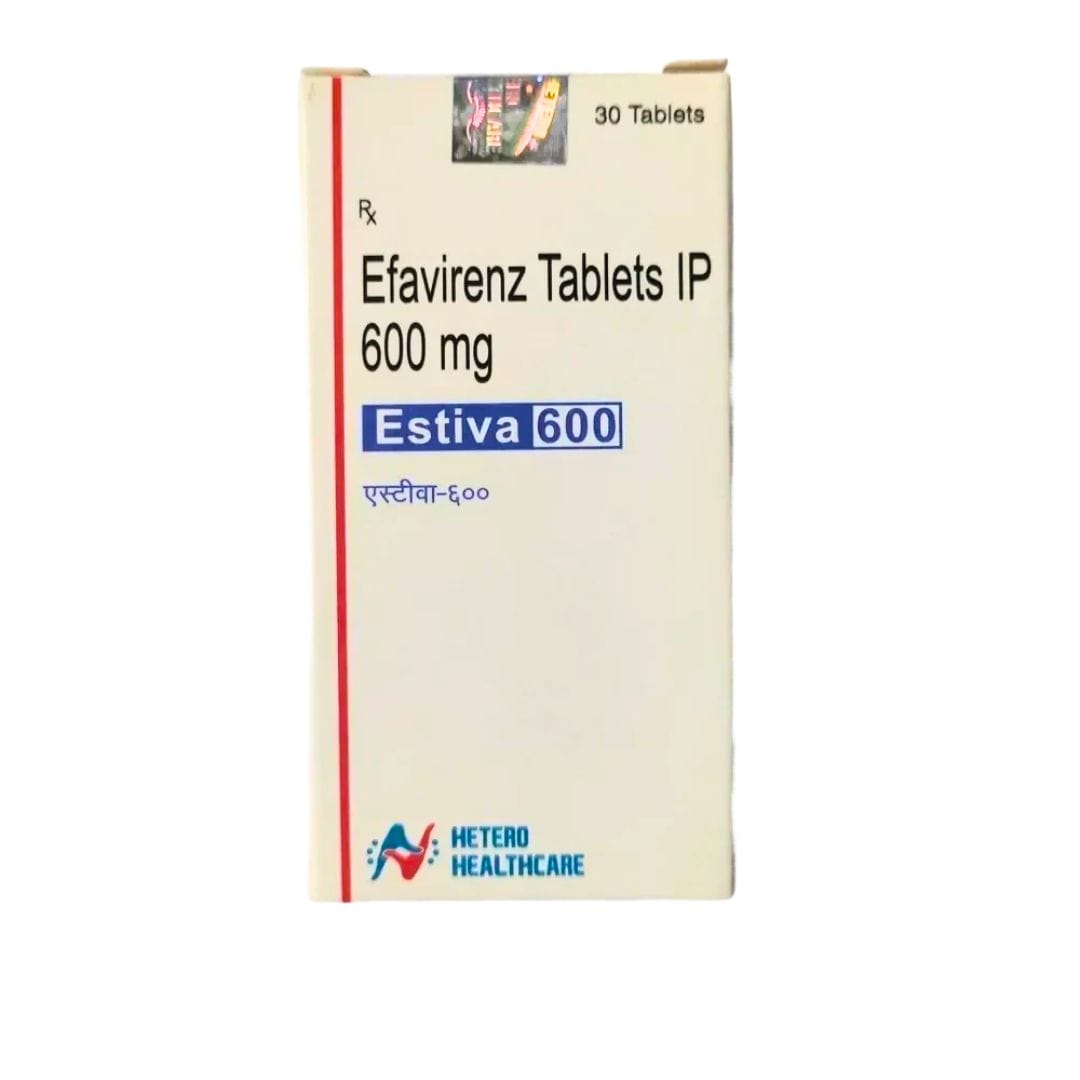
Estiva 600mg contains Efavirenz 600mg — an oral non-nucleoside reverse transcriptase inhibitor (NNRTI) and the active molecule in branded Sustiva® (Bristol Myers Squibb, USA) and Stocrin® (MSD/Merck, Europe/Africa). Manufactured by Hetero Drugs Ltd (Hyderabad, India) — one of India's largest antiretroviral producers and a major WHO-prequalified ARV supplier globally.
Other Indian brands at the same 600mg strength include: Efavir (Cipla), Efcure (Sun Pharma), Viranz (Aurobindo). All contain identical active substance.
Important clinical context: Efavirenz 600mg was the WHO preferred first-line HIV-1 treatment until June 2018. It was replaced as preferred by dolutegravir (DTG) due to superior tolerability and resistance profile. However, efavirenz 600mg remains a WHO-listed alternative with specific clinical roles where it is still the right choice — explained below.
Efavirenz 600mg is not obsolete — it remains clinically appropriate and WHO-recommended in specific situations:
| Clinical Situation | Why Efavirenz |
|---|---|
| TB-HIV coinfection on rifampicin | Efavirenz is the recommended NNRTI — rifampicin reduces dolutegravir exposure by 75%; efavirenz dose is simply increased to 800mg |
| Women where reliable contraception cannot be confirmed | DTG carries a small neural tube defect risk at conception — efavirenz is the documented alternative |
| Patients stable on existing efavirenz regimen | WHO does not recommend switching stable patients to DTG without clear clinical reason |
| Resource-limited settings where DTG is unavailable | Efavirenz remains in national formularies across Africa, Southeast Asia, and South Asia |
| DTG resistance or intolerance | Efavirenz-based regimen as alternative second-line option |
This is the honest clinical picture — and it is what buyers and prescribers actually need to know.
HIV replicates by converting its RNA genome into DNA using the enzyme reverse transcriptase. This DNA then integrates into the host cell's genome, producing new virus. Efavirenz is an NNRTI — it binds to a specific allosteric pocket on reverse transcriptase (not the active site), locking the enzyme in a non-functional conformation. This blocks DNA synthesis and stops HIV replication.
Unlike NRTIs (nucleoside analogues that compete at the active site), efavirenz's allosteric binding means it does not require intracellular activation and has a rapid onset of action. Plasma efavirenz levels reach steady state within 6–7 days of once-daily dosing.
Efavirenz does not cure HIV. It suppresses viral load to undetectable levels in combination with other antiretrovirals, preserving CD4 cell count and immune function, and preventing AIDS-defining illness.
| Patient | Dose | Timing |
|---|---|---|
| Adults and children ≥40kg | 600mg once daily | At bedtime on empty stomach |
| Children 25–40kg | 400mg once daily | At bedtime |
| Children 13–25kg | 200–300mg once daily | At bedtime |
| TB coinfection on rifampicin (≥50kg) | 800mg once daily | At bedtime |
Always take at bedtime on an empty stomach. This is the most important administration instruction. CNS side effects (dizziness, vivid dreams, insomnia) are most intense in the first 2–4 weeks — taking at bedtime means patients sleep through the worst of them. High-fat meals increase efavirenz absorption by up to 50%, increasing CNS side effect risk.
Always combined with 2 NRTIs — standard backbone: Tenofovir + Lamivudine (TDF/3TC) or Tenofovir + Emtricitabine (TDF/FTC). Fixed-dose combinations (Vonavir, Atripla, Trustiva: TDF + FTC + EFV) are available and preferred for adherence.
CNS effects — the defining characteristic of efavirenz: Dizziness, vivid dreams or nightmares, insomnia, difficulty concentrating, and a "floating" or dissociative sensation occur in 52% of patients in the first 2–4 weeks. These are predictable, manageable, and resolve in most patients within 4 weeks. Bedtime dosing significantly reduces impact. Patients must be counselled before starting — these effects are alarming if unexpected but harmless and temporary for most.
Common: Rash (usually mild, weeks 1–2, usually resolves without stopping treatment). Nausea. Raised liver enzymes.
Serious — report immediately: Severe rash with blistering or mucosal involvement (rare Stevens-Johnson syndrome). Severe depression, suicidal ideation, or psychosis — particularly in patients with pre-existing mental health conditions. Jaundice or severe liver enzyme elevation. Persistent CNS symptoms beyond 4 weeks at full intensity.
Pregnancy: Efavirenz has been associated with neural tube defects in early pregnancy in animal studies. Avoid in the first trimester. If pregnancy is detected during efavirenz treatment, do not abruptly stop — discuss with HIV specialist. Post-first-trimester use is generally considered acceptable.
Is Estiva the same as Sustiva? Yes — identical active molecule (efavirenz 600mg), manufactured by Hetero Drugs in a WHO-GMP facility. Same mechanism, same efficacy.
Has efavirenz been replaced by dolutegravir? Dolutegravir is now the WHO preferred first-line NNRTI alternative. However, efavirenz 600mg remains WHO-recommended for TB-HIV coinfection with rifampicin, for stable patients already on it, and where DTG is unavailable. It is not obsolete.
Why does efavirenz cause vivid dreams? Efavirenz crosses the blood-brain barrier and has activity at CNS receptors — producing the characteristic neuropsychiatric effects. Taking it at bedtime means the peak concentration occurs during sleep, significantly reducing waking impact. Most patients find these effects greatly diminish after 2–4 weeks.
Can I take Estiva with food? Take on an empty stomach at bedtime. High-fat meals significantly increase absorption and intensify CNS side effects — particularly in the first weeks of treatment.
Is Estiva used for HIV-2? No. Efavirenz is not effective against HIV-2 — the NNRTI binding pocket in HIV-2 reverse transcriptase has a different structure that confers intrinsic resistance to the entire NNRTI class.