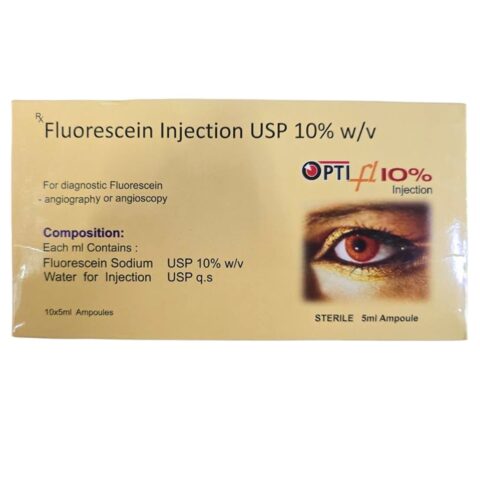
Fluorescein Injection is a sterile, single-use intravenous diagnostic solution containing Fluorescein Sodium at a concentration of 100 mg/mL (10%), packaged in a 5 mL single-dose glass vial. First approved in the United States in 1976, it is one of the most extensively used and clinically validated ophthalmic diagnostic agents in modern ophthalmology and retinal medicine.
Administered intravenously by a qualified healthcare professional, Fluorescein Injection is the essential diagnostic tool used in Fluorescein Fundus Angiography (FFA) — a procedure that allows detailed imaging and analysis of the retinal and choroidal vasculature to diagnose, monitor, and guide treatment of a wide range of serious ocular conditions.
This product is for diagnostic use only and must be administered exclusively by qualified physicians with technical expertise in performing and interpreting fluorescein angiography. It is supplied to ophthalmology clinics, eye hospitals, retinal treatment centers, and specialist medical facilities.
Fluorescein Fundus Angiography (FFA) of the Retina and Iris Vasculature
Fluorescein Injection is the primary indicated use — the diagnostic gold standard for evaluating the blood vessels at the back of the eye. During the procedure, Fluorescein Sodium is administered intravenously into the antecubital vein. As the dye circulates through the ocular vasculature, a fundus camera equipped with blue light illumination captures fluorescent images of the retinal and choroidal vessels in real time. Luminescence typically appears in the retinal and choroidal vessels within 7 to 14 seconds following injection, allowing continuous sequential imaging of the entire retinal circulation.
Fluorescein angiography is the definitive imaging modality for diagnosing and monitoring the following conditions:
Diabetic Retinopathy Diabetes is one of the leading causes of blindness worldwide. Fluorescein angiography enables precise identification of leaking blood vessels, areas of retinal ischemia, neovascularization, and macular edema — critical information for guiding laser treatment and anti-VEGF therapy decisions.
Age-Related Macular Degeneration (AMD) FFA is essential for differentiating between dry and wet AMD, identifying choroidal neovascular membranes (CNV), and monitoring the response to treatment with anti-VEGF agents.
Retinal Vein Occlusion (RVO) Fluorescein angiography provides detailed mapping of occluded vessels, areas of capillary non-perfusion, and collateral circulation development in both central and branch retinal vein occlusion.
Retinal Artery Occlusion FFA identifies areas of arterial occlusion, retinal ischemia, and vascular compromise with high accuracy, supporting urgent clinical decision-making.
Uveitis and Inflammatory Retinal Disease Fluorescein angiography reveals vascular leakage, disc staining, capillary dropout, and choroidal involvement in uveitis and related inflammatory conditions.
Angioscopy of the Iris Vasculature Fluorescein Injection is also indicated for angioscopy — the visual examination of iris blood vessels — supporting the diagnosis of rubeosis iridis and anterior segment neovascularization.
Chromovitrectomy Intravitreal fluorescein in low concentrations has been used during vitrectomy surgery to increase the visibility of vitreous fibrils, supporting safer and more precise surgical dissection.
Fluorescein Sodium is a synthetic organic fluorescent dye that responds to electromagnetic radiation between wavelengths of 465 to 490 nm (blue light). When excited by a blue light flash from a fundus camera, it emits light at wavelengths of 520 to 530 nm, producing a characteristic yellowish-green fluorescence that is captured by the imaging system.
Following rapid intravenous injection into the antecubital vein, fluorescein is distributed quickly throughout the circulatory system. Approximately 80% of fluorescein binds to plasma proteins — primarily albumin — while the unbound fraction circulates freely and is responsible for the visible fluorescence within the ocular vasculature. The dye demarcates the retinal and choroidal vasculature under observation, distinguishing normal from abnormal vascular patterns, areas of leakage, ischemia, neovascularization, and other pathological changes with high specificity.
Fluorescein is metabolized primarily to fluorescein monoglucuronide and is excreted predominantly through renal clearance. Systemic clearance is essentially complete within 48 to 72 hours of administration.
This product must be administered exclusively by qualified physicians in a clinical setting equipped with emergency resuscitation facilities.
Adult Dose
The standard adult dose of Fluorescein Injection 10% (100 mg/mL) is 500 mg administered intravenously — equivalent to the full 5 mL single-dose vial — injected rapidly into the antecubital vein at approximately 1 mL per second.
Pediatric Dose
For pediatric patients, the dose is calculated at 7.7 mg per kilogram of actual body weight (35 mg per 10 lbs / 4.54 kg) up to a maximum of 500 mg via intravenous administration.
Dose Reduction
A reduced dose of 200 mg (2 mL) may be appropriate when a highly sensitive imaging system such as a scanning laser ophthalmoscope is used. In patients with severe renal impairment (glomerular filtration rate below 20 mL/min), reduce the dose to 2.5 mL (half the standard dose).
Administration Procedure
Step 1 – Patient Assessment Conduct a full medical history before the procedure including history of allergy, asthma, eczema, cardiopulmonary disease, diabetes mellitus, and current medications — particularly beta-blocking drugs. Patients on beta-blockers require supervision by a physician experienced in intensive care and resuscitation.
Step 2 – Allergy Testing (if suspected) If a potential allergy is suspected, perform an intradermal skin test prior to intravenous administration by injecting 0.05 mL intradermally. Evaluate the test site 30 to 60 minutes following injection. A negative skin test does not exclude the possibility of an allergic reaction.
Step 3 – Preparation and Extravasation Check Attach a syringe filled with Fluorescein Injection to transparent tubing and a 23-gauge butterfly needle. Insert the needle and draw the patient’s blood to the hub of the syringe so that a small air bubble separates the patient’s blood from the fluorescein. With room lights on, slowly inject the blood back into the vein while observing the skin over the needle tip. If extravasation has occurred, the patient’s blood will visibly bulge the skin — stop the injection immediately. Proceed only when confident that extravasation has not occurred.
Step 4 – Injection Turn off room lighting and inject fluorescein rapidly (1 mL per second is recommended) into the antecubital vein. Luminescence typically appears in the retinal and choroidal vessels within 7 to 14 seconds.
Step 5 – Post-Procedure Monitoring Maintain venous access for a minimum of 5 minutes following injection to allow immediate treatment of any adverse reaction. Monitor the patient closely for at least 30 minutes following completion of the procedure.
Important: Do not mix or dilute Fluorescein Injection with other solutions or drugs. Flush intravenous cannulas with sterile 0.9% sodium chloride solution before and after administration to avoid incompatibility reactions. Do not inject via the intrathecal or intra-arterial routes.
Skin and Urine Discolouration Following administration, a temporary yellowish discolouration of the skin will occur within minutes and typically fades within 6 to 12 hours. Urine will attain a bright yellow colour and typically returns to normal within 24 to 36 hours. Patients must be informed of these expected effects prior to the procedure.
Driving The angiography procedure causes pupillary dilation. Patients must not drive a vehicle or operate machinery until their vision has fully returned to normal.
Breastfeeding Fluorescein Sodium is excreted in breast milk for up to 4 days following intravenous administration. Breastfeeding should be discontinued for at least 4 days following the procedure and milk should be expressed and discarded during this period.
Pregnancy Fluorescein Sodium should only be used in pregnant women when the clinical benefit clearly outweighs the risk. Animal studies have demonstrated that fluorescein crosses the placental barrier.
Fluorescein Injection is contraindicated in:
Rare cases of death due to anaphylaxis have been reported. An emergency resuscitation tray including epinephrine 1:1000 must always be available during and after the procedure.
The most commonly reported adverse reactions include:
Less common but clinically important adverse reactions include:
Seek immediate emergency medical intervention in the event of anaphylaxis, severe bronchospasm, cardiovascular collapse, or loss of consciousness.
Do not mix or co-administer Fluorescein Injection with other intravenous solutions, especially those with an acidic pH such as antihistamines. The alkaline pH of Fluorescein Sodium can cause precipitation when combined with acidic solutions. Flush the intravenous cannula with sterile 0.9% sodium chloride before and after each administration to prevent incompatibility.
Patients receiving beta-blocking medications — including ophthalmic formulations — require special precaution as beta-blockers reduce the vascular compensation response to anaphylactic shock and diminish the effectiveness of epinephrine in the event of cardiovascular collapse.
Store at 2 to 25 degrees Celsius (36 to 77 degrees Fahrenheit). Do not freeze. Store in the original packaging to protect from light. This is a single-use product — discard any unused portion after administration. Do not use if the solution shows visible particulate matter, discolouration, or if the vial or ampoule is cracked or damaged. Dispose of unused product and waste materials in accordance with local regulatory standards for pharmaceutical waste.
What is Fluorescein Injection used for? Fluorescein Injection is used as a diagnostic aid in fluorescein angiography of the retina and iris vasculature. It helps ophthalmologists visualize and photograph the blood vessels at the back of the eye to diagnose conditions including diabetic retinopathy, macular degeneration, retinal vein occlusion, and uveitis.
Who administers Fluorescein Injection? Fluorescein Injection must be administered exclusively by qualified physicians with technical expertise in performing and interpreting fluorescein angiography. It is not for self-administration.
How long does it take to see fluorescence after injection? Luminescence typically appears in the retinal and choroidal vessels within 7 to 14 seconds following intravenous injection.
Will my skin or urine change colour after the procedure? Yes. A temporary yellowish discolouration of the skin is expected and usually fades within 6 to 12 hours. Urine will appear bright yellow and typically clears within 24 to 36 hours. These are expected and harmless effects of the dye.
Can I drive after the procedure? No. The procedure involves pupillary dilation and patients must not drive or operate machinery until their vision has fully returned to normal.
Is Fluorescein Injection safe during pregnancy or breastfeeding? Use during pregnancy should only occur when the clinical benefit clearly outweighs the potential risk. Breastfeeding must be discontinued for at least 4 days following the procedure, with expressed milk discarded during this period.
Do you supply Fluorescein Injection to hospitals and clinics in USA, UK, and UAE? Yes. We supply Fluorescein Injection to ophthalmology clinics, retinal treatment centers, and hospitals in the United States, United Kingdom, UAE (Dubai, Abu Dhabi), Saudi Arabia, Australia, and internationally.
Medically Reviewed Content This product description has been written in accordance with clinical pharmacology guidelines and publicly available pharmaceutical references including the FDA-approved prescribing information for Fluorescite (Alcon Laboratories), the UK Electronic Medicines Compendium (EMC) Summary of Product Characteristics, DailyMed (NIH), Drugs.com prescribing information, and Medscape drug monographs. This product is for professional diagnostic use only and must be administered by a qualified physician in a clinically supervised setting.
Orders ship from our India Head Office within 1–2 business days of confirmation. We include full customs documentation — HS codes, certificates of origin, and pharmaceutical export permits.
Estimated delivery: 3–7 business days to UK. 7–10 business days to UAE, Saudi Arabia and Gulf countries. 10–15 days for USA and Asian countries.
All packages arrive in plain, unmarked brown boxes. No pharmacy name or medication details on the outside.
Only logged in customers who have purchased this product may leave a review.



Reviews
There are no reviews yet.