The Drug That Literally Changed Faces — and Lives
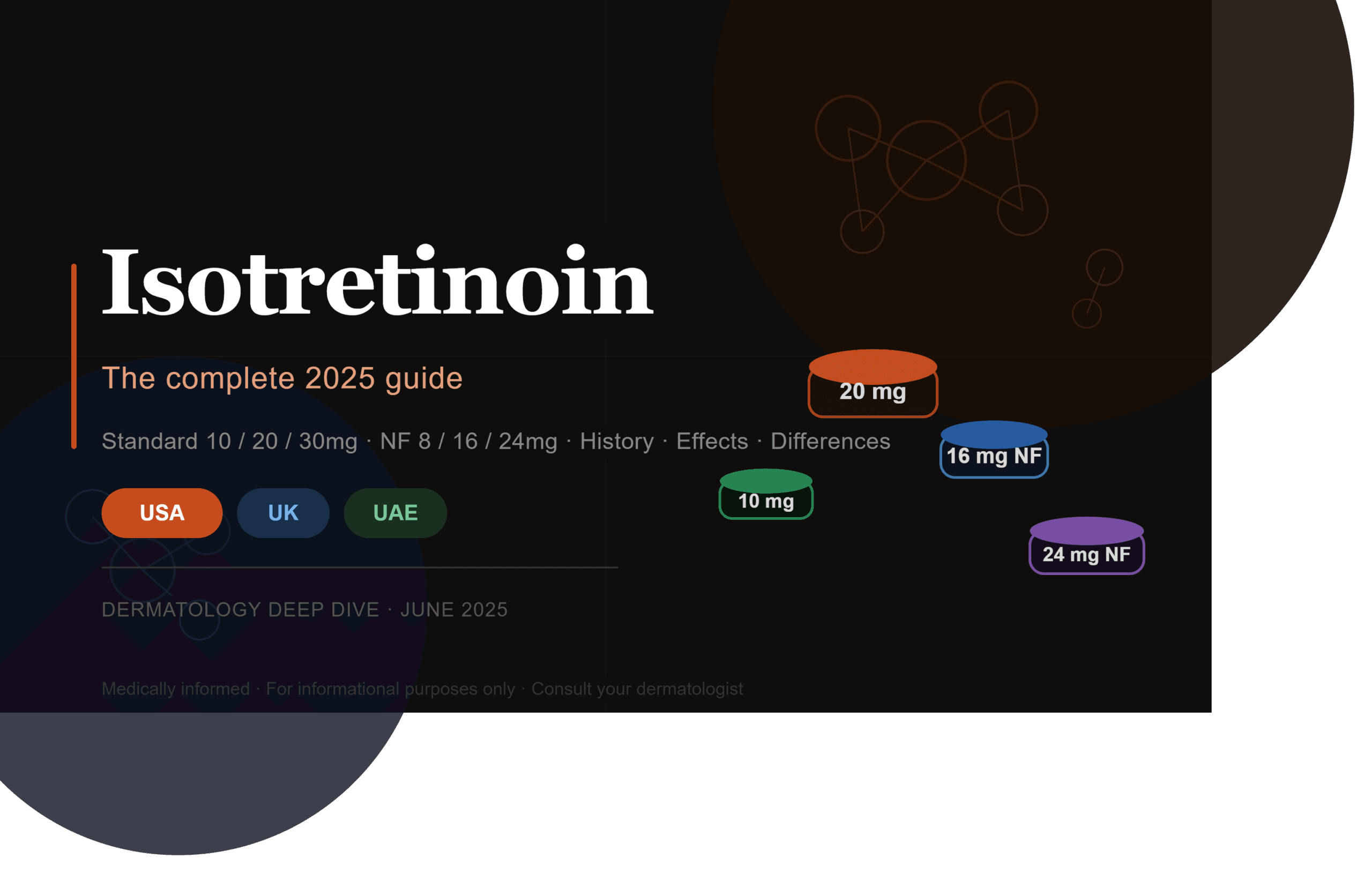
The complete guide to isotretinoin: its remarkable history, how it works, every dose explained — and why the new NF formulations are rewriting the rulebook
| Statistic | Figure | What It Means |
| Clear skin after one course | ~85% | Percentage of patients achieving clear or near-clear skin |
| FDA Approval Year | 1982 | Over 40 years of real-world safety and efficacy data |
| Years of Research | 60+ | Dating back to Roche’s original synthesis in the 1960s |
| Standard Oral Bioavailability | ~20% | The core problem that NF formulations are designed to solve |
| Statistic | Figure | What It Means |
| Clear skin after one course | ~85% | Percentage of patients achieving clear or near-clear skin |
| FDA Approval Year | 1982 | Over 40 years of real-world safety and efficacy data |
| Years of Research | 60+ | Dating back to Roche’s original synthesis in the 1960s |
| Standard Oral Bioavailability | ~20% | The core problem that NF formulations are designed to solve |
What You Will Learn in This Guide
- The remarkable history of isotretinoin
- How isotretinoin works — the science, simply explained
- Standard dosing: 10mg, 20mg, and 30mg
- The NF revolution: 8mg, 16mg, and 24mg
- Standard vs NF — the definitive head-to-head comparison
- Side effects, risks, and how to manage them
- Real stories: how isotretinoin changes lives
- Frequently asked questions
1. The Remarkable Origin Story
Few drugs carry as much mythology as isotretinoin. It wasn’t developed to cure acne. It wasn’t even developed to treat skin at all. It was an accident of science — and one of the most consequential ones in the history of dermatology.
Isotretinoin (13-cis retinoic acid) is a vitamin A derivative — a retinoid — first synthesised by the Swiss pharmaceutical giant Hoffmann-La Roche in the 1960s. The original goal? Cancer treatment. Researchers studying how compounds affected cell growth noticed something extraordinary happening to the skin of their subjects.
A Timeline of 60 Years
1960s — Birth at La Roche: Hoffmann-La Roche synthesises isotretinoin as part of broader retinoid research. Initial studies focus on potential benefits in cancer-related conditions, particularly those affecting cell proliferation. Nobody is thinking about acne yet.
1970s — The NIH Discovers Its Skin Power: Dermatologist Gary Peck at the National Institutes of Health administers isotretinoin to patients with severe skin disorders including ichthyosis and Darier’s disease. The results on sebaceous glands — the oil-producing machinery behind acne — are extraordinary. The so-called “Acne Mafia”, a trio of prominent dermatologists including Dr Jim Leyden at the University of Pennsylvania, spearheads the clinical push for acne treatment.
1979 — Clinical Breakthrough: First landmark clinical trials demonstrate that isotretinoin is devastatingly effective against severe nodulocystic acne — a form so destructive it leaves permanent, disfiguring scars and causes profound psychological damage. Nothing else had ever achieved this.
1982 — FDA Approval: The FDA approves isotretinoin under the brand name Accutane. It becomes the first oral acne-specific drug to provide prolonged, lasting remissions. It remains the most effective acne treatment ever discovered.
2002 — Regulatory Reckoning: Following mounting concerns about teratogenicity (severe birth defects), the FDA strengthens risk management. The US eventually mandates the iPLEDGE pregnancy prevention programme — one of the most stringent drug safety programmes in American pharmaceutical history.
2010s onwards — The NF Era: Next-generation micronised and lipid-matrix formulations (the “NF” generation) dramatically enhance bioavailability. Lower doses deliver equivalent — or superior — drug exposure. A quieter revolution begins.
Today, isotretinoin is approved or prescribed under dozens of brand names globally: Accutane and Claravis in the USA, Roaccutane in the UK and UAE, and many generic equivalents. The molecule itself is unchanged. The science around it has deepened for over six decades.
2. How Isotretinoin Actually Works
Acne is not one problem — it is four problems happening simultaneously. This is why simple antibiotics or topicals only solve part of the puzzle. Isotretinoin is the only treatment that addresses all four causes at once.
The Four Targets
1 — Sebum overproduction: Isotretinoin shrinks sebaceous glands by up to 90% and dramatically reduces oil output, cutting off acne’s primary fuel source.
2 — Clogged pores (comedones): It normalises skin cell turnover, preventing dead cells from accumulating and blocking follicles — the initial trigger of every pimple.
3 — Bacterial proliferation: By reducing sebum (the food source of C. acnes bacteria), isotretinoin indirectly but powerfully controls bacterial growth without being an antibiotic.
4 — Inflammation: Through its immunomodulatory properties, it suppresses the inflammatory cascade that turns a blocked pore into a red, painful, scarring nodule.
How It Compares to Other Treatments
| Treatment | Sebum Reduction | Pore Clearing | Antibacterial | Anti-inflammatory | Score |
| Isotretinoin | ✓ Yes | ✓ Yes | ✓ Indirect | ✓ Yes | 4 / 4 |
| Oral Antibiotics | ✗ No | ✗ No | ✓ Yes | ✓ Yes | 2 / 4 |
| Topical Retinoids | ✗ No | ✓ Yes | ✗ No | ✓ Mild | 2 / 4 |
| Benzoyl Peroxide | ✗ No | ✓ Partial | ✓ Yes | ✗ No | 2 / 4 |
This multi-mechanism action is why isotretinoin achieves something no other drug manages: long-term remission. Not just suppression — actual remission. Many patients require only a single course and never experience severe acne again.
| KEY INSIGHT
Isotretinoin is the only therapy that impacts all major causative factors in acne. Its efficacy has not been superseded by any other treatment in over 40 years of dermatology research. The science has evolved; the supremacy has not. |
3. Standard Dosing: 10mg, 20mg & 30mg
Standard isotretinoin capsules come in fixed strengths. Treatment is always weight-based — your doctor calculates a target cumulative dose (typically 120–150 mg per kg of body weight), then determines how to get there over 4–6 months.
The Three Standard Strengths
| Strength | Typical Patient | Course Length | Daily Protocol | Food Required? |
| 10 mg | Starting dose / low-weight / adolescent | 6–9 months | Once or twice daily | Yes — fatty meal |
| 20 mg | Average adult (under 70 kg) | 4–6 months | Twice daily | Yes — fatty meal |
| 30 mg | Heavier patients / higher severity | 4–5 months | Twice daily | Yes — fatty meal |
| ⚠️ CRITICAL POINT
Standard isotretinoin has notoriously low and variable oral bioavailability — approximately 20% when taken without food. Absorption nearly doubles when taken with a high-fat meal. This food dependency is one of the major limitations of conventional formulations, and the core problem the NF generation was engineered to solve. |
European guidelines typically suggest 0.3–0.5 mg/kg/day; US guidelines allow up to 1 mg/kg/day. Practices vary by country and clinician.
4. The NF Revolution: 8mg, 16mg & 24mg
Here is something that surprises many patients and even some clinicians: a 16 mg capsule of a next-generation isotretinoin formulation can deliver the same therapeutic drug exposure as a conventional 20 mg capsule. You are taking less — but your body is absorbing more of it, more consistently.
This is the promise of what the industry loosely terms “NF” (new formulation) isotretinoin — a family of advanced delivery technologies that overcome the fundamental limitations of the original capsule.
The Science Behind NF
| 🔬 THE SCIENCE BEHIND NF
Standard isotretinoin particles average around 100 microns in size, yielding roughly 20% bioavailability. NF technologies — including LIDOSE® lipid matrix, SEDDS® (Self-Emulsifying Drug Delivery Systems), and micronisation to nanoparticle scale — dramatically increase surface area and solubility. The result: significantly higher bioavailability, and crucially, reduced dependency on food for absorption. |
NF Dose Guide
| NF Strength | Equivalent Standard Dose | Profile | Best For |
| 8 mg NF | ~10 mg standard | Low / starter | Starting therapy, sensitive patients, maintenance, adolescents |
| 16 mg NF ★ | ~20 mg standard | Standard NF | Most adult patients — same results as 20 mg, lower pill burden |
| 24 mg NF | ~30 mg standard | Higher NF | Heavier patients or more severe acne, with better absorption consistency |
NF Brands You Will Encounter
| Brand | Technology | Strengths | Key Benefit | Region |
| Absorica® | SEDDS lipid matrix | 8, 16, 24, 32 mg | Food-independent absorption | USA |
| Absorica LD® | Enhanced SEDDS | 8, 16, 24 mg | Lower dose equivalent; LD = lower dose | USA |
| Aknekutan® | LIDOSE® lipid matrix | 8, 16, 24 mg | Reduced food effect, fewer relapses reported | Europe / UAE |
| Roaccutane® | Standard oil suspension | 10, 20, 40 mg | Long-established; the original brand | UK / UAE / Global |
5. Standard vs NF — The Definitive Head-to-Head
This is the question most patients — and many prescribers — want answered directly. Here is the most honest, complete comparison available.
Side-by-Side Comparison
| Factor | Standard Isotretinoin | NF Isotretinoin |
| Bioavailability | ~20% (fasted); ~40% (fed) | Significantly higher and more consistent |
| Food requirement | Mandatory — fatty meal required | Not required; minimal food effect |
| Dosing | 10 / 20 / 30 mg | 8 / 16 / 24 mg (lower mg, same exposure) |
| Absorption variability | High — unpredictable between patients | Lower — more predictable blood levels |
| Relapse rates | Standard | Reduced in LIDOSE studies |
| Cost | Lower; widely generic | Higher; may not be covered by insurance |
| Global availability | Universal | Variable; less available in some markets |
| Years of safety data | 40+ years | 10+ years for NF platforms |
Dose Equivalency Table
| Standard Dose | NF Equivalent | Dose Reduction | Food Needed (NF)? | Absorption Consistency |
| 10 mg | 8 mg NF | 20% lower | Not required | Higher with NF |
| 20 mg | 16 mg NF | 20% lower | Not required | Higher with NF |
| 30 mg | 24 mg NF | 20% lower | Not required | Higher with NF |
Total Course Dose (for a 70 kg patient targeting 120 mg/kg cumulative)
| Patient Weight | Standard Total (mg) | NF Total (mg) | Saving (mg) |
| 50 kg | 6,000 mg | 4,800 mg | 1,200 mg |
| 70 kg | 8,400 mg | 6,720 mg | 1,680 mg |
| 90 kg | 10,800 mg | 8,640 mg | 2,160 mg |
| BOTTOM LINE
NF formulations are not just marketing — the pharmacokinetic advantage is real, peer-reviewed, and clinically meaningful. For patients who previously saw poor results, failed courses, or high side effect burden with standard isotretinoin, the NF formulations deserve serious consideration. The same drug, delivered better. |
6. Side Effects: Honest, Complete, Unfiltered
No guide to isotretinoin is complete — or trustworthy — without an honest accounting of side effects. This drug is powerful. It works because it is powerful. Knowing what to expect, and how to manage it, is half the battle.
Common & Expected (Most Patients Will Experience These)
- Dry lips (cheilitis): Near-universal. Use a thick lip balm from day one — and keep it everywhere.
- Dry skin & face: Moisturise constantly with fragrance-free products. Avoid harsh cleansers.
- Dry eyes: Use preservative-free eye drops. Contact lens wearers may need a break.
- Dry nasal passages and nosebleeds: Saline nasal spray and a humidifier help significantly.
- Initial acne flare (the “purge”): Many patients see a worsening in weeks 2–6 before improvement begins. This is normal and expected.
- Sun sensitivity: SPF 50 daily is non-negotiable. Tanning booths are off-limits entirely.
Serious & Monitored Risks
| Risk | How Common | What’s Done About It |
| Teratogenicity (birth defects) | Certain if pregnant | Mandatory pregnancy prevention (iPLEDGE in USA); monthly blood tests and pregnancy tests |
| Elevated liver enzymes | Uncommon (~5–10%) | Monthly blood tests; alcohol must be strictly avoided throughout course |
| Elevated triglycerides | Relatively common | Monitored via blood tests; diet modification or dose adjustment |
| Depression / mood changes | Debated; under active study | Patients and doctors advised to monitor closely; discontinue if significant changes occur |
| Inflammatory bowel disease | Very rare; evidence mixed | Report any persistent gastrointestinal symptoms to your doctor immediately |
| ⚠️ MENTAL HEALTH NOTE
The relationship between isotretinoin and depression remains one of the most debated questions in dermatology. Current evidence does not establish a definitive causal link, and some studies suggest severe acne itself causes depression that resolves with treatment. However, any patient experiencing mood changes should contact their doctor immediately. This is not a reason to avoid treatment — it is a reason to be properly monitored throughout the course. |
7. How Isotretinoin Changes Lives
Statistics describe a drug. Stories describe what it means to be a person. Behind every prescription is someone who has tried everything else — who has cancelled plans, avoided cameras, felt ashamed of their own skin. Isotretinoin, uniquely, ends that story for most patients.
| “I spent four years trying antibiotics, every topical cream you can name, two different contraceptives. My acne left scars I’ll have forever. Two months after starting isotretinoin, my skin started clearing. By month four, I couldn’t recognise myself — in the best possible way. It wasn’t just my face. It was my confidence, my willingness to be in photos, to go on dates. A drug gave me my life back.”
— Patient testimony (composite account representing common reported experiences) |
The psychological impact of severe acne is well-documented and often underestimated. Studies consistently find that acne severity correlates with anxiety, depression, social withdrawal, and impaired quality of life — sometimes at levels comparable to chronic systemic diseases.
Quality of Life Improvement (DLQI Scores)
The Dermatology Life Quality Index (DLQI) measures impact on daily life, where lower scores indicate better quality of life. Studies consistently show dramatic improvements after a full isotretinoin course.
| Life Domain | Before Treatment (avg) | After Treatment (avg) | Improvement |
| Skin symptoms | 8.2 / 10 | 1.8 / 10 | 78% improvement |
| Emotional wellbeing | 7.6 / 10 | 1.4 / 10 | 82% improvement |
| Social functioning | 6.9 / 10 | 1.2 / 10 | 83% improvement |
| Daily activities | 5.4 / 10 | 0.9 / 10 | 83% improvement |
| THE NUMBERS BEHIND THE STORIES
Studies consistently show 85–90% of patients achieve clear or near-clear skin after a single course. Of those who relapse, a second course is typically highly effective. Scarring acne that disfigures and damages self-esteem can, in most cases, be stopped in its tracks — if treatment begins early enough. |
8. Frequently Asked Questions
Is isotretinoin a steroid?
No. Isotretinoin is a retinoid — a derivative of vitamin A. It is not a steroid and does not carry the risks associated with steroid use. The two drug classes are pharmacologically unrelated.
How long does a course last?
Typically 4–6 months for standard dosing, depending on body weight and target cumulative dose. Some low-dose or NF-based protocols are extended over a longer period at lower daily doses. Your dermatologist will calculate a personalised course based on your weight and response.
What is the real difference between Roaccutane, Accutane, Claravis and generics?
They all contain isotretinoin as the active ingredient. The differences are formulation (which affects bioavailability), excipients, and country of availability. Generic versions are bioequivalent by regulatory standards. Roaccutane is the original Roche brand used in most markets outside North America.
Do I have to take isotretinoin with food?
Standard isotretinoin — yes, with a fatty meal, to maximise absorption. NF formulations (Absorica, Aknekutan) were specifically designed to overcome this limitation. They can be taken without food with minimal impact on absorption, which significantly improves convenience and consistency.
Can isotretinoin cure acne permanently?
For many patients, a single course results in long-term, sometimes permanent remission. Approximately 85% achieve clear skin. Of those who relapse — more common in younger patients or those who completed a lower cumulative dose — a second course is typically effective.
Is NF isotretinoin better? Should I ask for it specifically?
NF formulations offer genuine pharmacokinetic advantages: higher, more consistent bioavailability and reduced food dependency. They are particularly valuable for patients who previously had poor results, unpredictable side effects, or who struggle to take medication with a fatty meal reliably. They are more expensive and less universally available. It is a conversation worth having with your dermatologist, armed with the facts.
Can I drink alcohol on isotretinoin?
You should not. Isotretinoin is processed by the liver, and alcohol increases the risk of elevated liver enzymes and triglyceride levels — both of which are monitored during treatment. Even moderate alcohol consumption should be avoided for the full course.
Is isotretinoin safe for teenagers?
Yes, with appropriate monitoring. It is one of the most effective treatments for teenage acne, particularly severe or scarring forms. The risk of leaving severe acne untreated — psychologically and physically — often outweighs the risks of a properly monitored course.
References & Further Reading
- Khan A et al. (2025). The history, development and current status of isotretinoin. Clinical and Experimental Dermatology.
- Paichitrojjana A et al. (2023). Oral Isotretinoin and Its Uses in Dermatology. Drug Design, Development and Therapy, 17, 2573–2591.
- Bershad SV. (2001). The modern age of acne therapy. Mt Sinai Journal of Medicine, 68(4–5), 279–86.
- Hosny KM et al. (2020). Nanotechnology, hepato-protective agents and bioavailability of isotretinoin. Drug Delivery.
- FDA iPLEDGE Programme documentation. US Food & Drug Administration.
- Roche LIDOSE pharmacokinetic study data (SMB-ISO-SD011). Bioequivalence of Roaccutane 20 mg and isotretinoin 16 mg NF.
| MEDICAL DISCLAIMER
This article is for informational purposes only and does not constitute medical advice. Isotretinoin is a prescription-only medicine. Always consult a qualified healthcare professional or dermatologist before beginning, changing, or stopping any treatment. Information is accurate to the best of the author’s knowledge as of June 2025 but is not a substitute for professional medical guidance. |
Looking to Buy Isotretinoin Online?
Milan Medicals supplies high-quality Isotretinoin capsules in multiple strengths, including standard and NF (micronized) formulations for acne treatment.
Need help choosing between Isotretinoin 10mg, 20mg, or NF 16mg? Contact our team for assistance.