Start shopping and find your next favourite medicine.
Browse Catalog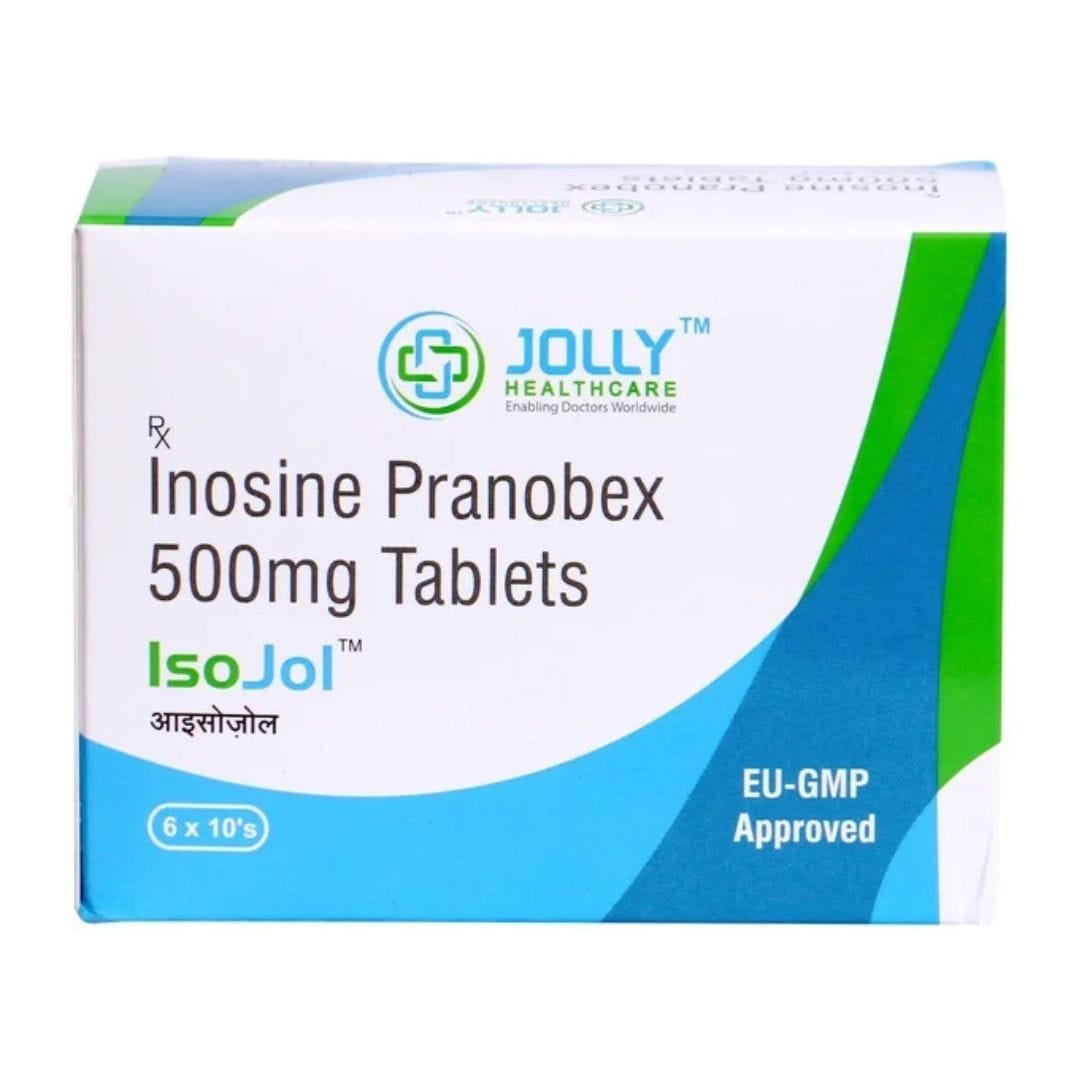
Reviewed by a licensed physician | Last updated: April 2026 Prescription advised | Consult a qualified healthcare provider before use
Isojol 500mg is an oral antiviral immunomodulator tablet containing Inosine Pranobex 500mg — the active molecule sold globally as Isoprinosine® (Teva Russia; Newport Philippines; Mochida Japan; Ewopharma Eastern Europe; Sanofi Belgium) and Imunovir® (UK). All these branded products contain the identical active substance — inosine acedoben dimepranol — at the same 500mg strength.
Manufactured by Jolly Healthcare at their WHO-GMP certified facility in Haridwar, India, Isojol is exported to the United States, United Kingdom, UAE, Philippines, Saudi Arabia, Australia, Canada, and beyond — giving patients worldwide access to this clinically established antiviral at significantly lower cost than originator brands.
Inosine pranobex is not a new molecule. It has been in continuous clinical use since 1971 — over 50 years — and is currently marketed in more than 70 countries for the treatment of viral infections. Despite this long track record, it remains one of the least understood drugs by patients outside Eastern Europe and the Philippines, where it is widely prescribed. Its unique status as both an antiviral and an immune system booster sets it apart from all other antiviral drugs in clinical use.
Important note for US patients: Inosine pranobex is not FDA-approved for commercial sale in the United States but holds an FDA Orphan Drug designation for SSPE. Personal importation of a limited personal supply is permitted under Section 321 of the Federal Food, Drug, and Cosmetic Act for individual use. US patients sourcing Isojol should consult their physician and understand applicable import rules.
Most antiviral drugs work in one of two ways — they either attack the virus directly, or they boost the immune system. Inosine pranobex in Isojol 500mg does both simultaneously:
Mechanism 1 — Direct antiviral action: Inosine pranobex interacts with viral RNA, interfering with the ability of viruses to replicate inside host cells. It has demonstrated direct antiviral activity against herpes simplex virus (HSV-1, HSV-2), varicella-zoster virus (VZV), cytomegalovirus (CMV), Epstein-Barr virus (EBV), human papillomavirus (HPV), influenza, and measles virus in clinical and laboratory studies.
Mechanism 2 — Immunomodulation: The dimepranol acedoben component acts as an immunological adjuvant — it enhances the host immune response to viral infections by:
The combination of these two mechanisms means Isojol 500mg works where standard antivirals have limited effect — in persistent viral infections where the immune system has failed to clear the virus on its own, such as persistent HPV, recurrent herpes, and the chronic viral encephalitis of SSPE.
Human papillomavirus (HPV) is the most common sexually transmitted infection in the world — affecting an estimated 300 million people at any given time. While many HPV infections clear spontaneously, a significant proportion persist — particularly HPV types 16, 18, 6, and 11 — leading to genital warts, cervical intraepithelial neoplasia (CIN), and cervical cancer.
Inosine pranobex is one of very few oral agents with clinical evidence for both clearing HPV infection and reducing recurrence after physical treatments. Key published data:
In a randomised, double-blind, placebo-controlled trial of 55 patients with genital warts, a 4-week course of inosine pranobex 3g daily significantly improved clinical response to conventional treatment compared to placebo. In a study of cervical HPV infection, HPV negative results were obtained in 35.5% of patients after routine treatment alone versus 54.8% with inosine pranobex monotherapy and 84.2% with inosine pranobex combined with standard treatment. In patients with cervical HPV-16 and HPV-18 infection, inosine pranobex caused HPV negativity in 77.8% of patients after the first course of therapy. In a separate study, effectiveness of isoprinosine in treating HPV-16 infected patients was 87.5% after one therapy cycle and 100% after two therapy cycles.
Standard dose for genital warts: 1g (two Isojol 500mg tablets) three times daily (3g/day total) for 14–28 days, as adjunctive therapy to podophyllin or CO2 laser treatment. This combination — physical destruction of warts plus immune restoration with inosine pranobex — dramatically reduces recurrence rates compared to physical treatment alone.
Standard dose for HPV cervical infection: 1g (two Isojol 500mg tablets) three times daily for cycles of 5–10 days, repeated after a 1-week rest period, for 3–6 cycles.
Isojol 500mg is indicated for mucocutaneous herpes simplex infections — both oral herpes (HSV-1, cold sores, fever blisters) and genital herpes (HSV-2). It reduces the severity and duration of outbreaks and — critically — has been shown in clinical trials to reduce the frequency of recurrent genital herpes when used as a suppressive course.
The combination of inosine pranobex with acyclovir has been shown to be more effective in preventing recurrent herpes infections than either agent alone — making Isojol a useful adjunct to standard antiherpetic therapy in patients with frequent recurrences.
Standard dose for mucocutaneous herpes simplex: 1g (two Isojol 500mg tablets) four times daily (4g/day total) for 7–14 days.
Subacute sclerosing panencephalitis (SSPE) is a rare, progressive, and fatal neurological disease caused by a persistent measles virus infection of the brain, typically occurring years after the initial measles infection. It primarily affects children and young adults. There is no cure for SSPE — but inosine pranobex is the first antiviral agent ever used to treat SSPE and is the only oral agent with demonstrated evidence of prolonging life expectancy and delaying neurological deterioration in SSPE patients.
Inosine pranobex for SSPE is typically used in combination with intrathecal interferon alpha (IFN-α) in specialist neurological settings. The ISOP CARES study documented 61% positive clinical outcomes in SSPE patients treated with inosine pranobex — a remarkable result given the otherwise universally fatal natural history of the disease.
SSPE dose: 50–100 mg/kg/day in divided doses every 4–6 hours — weight-based, under neurologist supervision.
This indication carries FDA Orphan Drug designation in the United States. While not commercially approved in the US market, US physicians may prescribe and patients may personally import inosine pranobex for SSPE under existing regulatory provisions.
In a Phase 4, randomised, double-blind, placebo-controlled trial, inosine pranobex significantly reduced the severity and duration of confirmed acute respiratory viral infections, including influenza and influenza-like illness. It works in respiratory infections by enhancing NK cell cytotoxicity — accelerating the immune system’s ability to identify and eliminate virally infected respiratory tract cells. This indication is recognised in Eastern European countries (Czech Republic, Poland, Slovakia, Russia) where inosine pranobex is widely prescribed for acute upper respiratory infections.
Standard dose for acute respiratory viral infections: 1g (two Isojol 500mg tablets) three to four times daily for 5–7 days.
Clinical studies have documented activity of inosine pranobex against EBV (glandular fever/mononucleosis) and CMV, particularly through its immunomodulatory enhancement of T-cell and NK-cell responses. It is used as adjunct therapy in EBV-related chronic fatigue, persistent CMV infection, and post-viral immune suppression in specialist settings.
All doses are standard adult dosing. Paediatric doses are calculated at 50–100 mg/kg/day in divided doses. Always follow your prescribing physician’s specific instructions.
Genital warts (adjunct to podophyllin or laser): 1g three times daily (6 tablets/day) for 14–28 days.
Herpes simplex (cold sores/genital herpes — acute episode): 1g four times daily (8 tablets/day) for 7–14 days.
HPV cervical infection: 1g three times daily for 5-day cycles with 1-week rest between cycles, repeated for 3–6 cycles.
Acute respiratory viral infection: 1g three to four times daily for 5–7 days.
SSPE: 50–100 mg/kg/day in 4–6 equally spaced doses, under neurologist supervision.
How to take: Take with food or milk to reduce the risk of nausea and stomach upset. Swallow whole with a full glass of water. Drink extra water throughout treatment to reduce the risk of uric acid buildup.
Do not use if: you have gout or raised serum uric acid levels — inosine pranobex increases uric acid production and can trigger gout attacks or urate kidney stones; you have severe renal impairment or a history of uric acid kidney stones; you have a known hypersensitivity to inosine pranobex or any tablet excipient; you are on immunosuppressant medications — concurrent immunosuppression counteracts inosine pranobex’s immunostimulatory mechanism.
Use with caution in: patients with mild to moderate renal impairment — ensure adequate fluid intake; patients with a personal or family history of gout; pregnant women — SSPE can progress rapidly during pregnancy, use only under specialist supervision; elderly patients with pre-existing renal impairment.
Inosine pranobex has a well-documented safety profile over 50 years of clinical use. It is considered one of the best-tolerated antivirals in clinical practice.
Common: Transient nausea — take with food to minimise. Mild stomach discomfort or indigestion.
Uncommon: Reversible rise in serum uric acid — occurring in approximately 10% of patients taking standard doses. This is reversible on stopping treatment and is rarely clinically significant unless the patient has pre-existing gout or renal impairment. Mild headache. Skin dryness in older female patients on prolonged courses.
Important: The rise in uric acid is predictable and manageable. Increase daily fluid intake to at least 2–2.5 litres during treatment, and avoid high-purine foods (organ meats, shellfish, beer) during prolonged courses.
There are no serious organ-toxic effects. Continuous administration for up to 7 years at doses ranging from 1g to 8g per day has produced no serious adverse events in clinical studies.
Is Isojol the same as Isoprinosine? Yes. Both contain identical active substance — inosine pranobex 500mg. Isoprinosine is the branded originator sold in Russia (Teva), Philippines (Newport), Japan (Mochida), Belgium (Sanofi), and Eastern Europe (Ewopharma). Isojol is the Indian generic manufactured by Jolly Healthcare — same molecule, same strength, lower price.
Can Isojol clear HPV infection? Clinical trial data shows that inosine pranobex can achieve HPV negativity in 54–87% of patients in combination with standard treatments, compared to 35% with standard treatment alone. It does not guarantee clearance but significantly improves the chances. Your gynaecologist can advise on a treatment schedule based on HPV type and cervical findings.
How long do I take Isojol for HPV? For genital warts, a 14–28 day course alongside physical treatment (laser, podophyllin) is standard. For cervical HPV, repeated 5-day cycles over 3–6 months are commonly used. Duration depends on HPV type, clinical response, and your physician’s assessment.
Can I take Isojol for recurring cold sores? Yes. For recurrent herpes simplex (both oral and genital), inosine pranobex is used at 1g four times daily for 7–14 days during outbreaks. Combined use with acyclovir has shown superior results in preventing recurrence compared to either agent alone.
Is Isojol available in the USA? Inosine pranobex does not have FDA marketing approval in the USA but holds an FDA Orphan Drug designation for SSPE. US individuals may personally import a limited supply under existing FDA personal import provisions. Patients should consult their physician before use.
Does Isojol raise uric acid? Yes — a transient, reversible rise in uric acid occurs in approximately 10% of patients. It resolves on stopping treatment. Patients with gout or uric acid kidney stones should not use this medication. For all other patients, increasing fluid intake during treatment minimises this risk.
Can I take Isojol during pregnancy? Use only under specialist medical supervision. In SSPE patients specifically, the disease can progress rapidly during pregnancy, making treatment essential under neurologist guidance. For HPV and herpes indications, discuss risk-benefit with your gynaecologist.
Do you ship Isojol 500mg internationally? Yes — discreet, secure shipping to USA, UK, UAE (Dubai, Abu Dhabi), Philippines, Russia, Poland, Canada, Australia, South Africa, Saudi Arabia.
Orders ship from our India Head Office within 1–2 business days of confirmation. We include full customs documentation — HS codes, certificates of origin, and pharmaceutical export permits.
Estimated delivery: 3–7 business days to UK. 7–10 business days to UAE, Saudi Arabia and Gulf countries. 10–15 days for USA and Asian countries.
All packages arrive in plain, unmarked brown boxes. No pharmacy name or medication details on the outside.



Reviews
There are no reviews yet