Fertility · Ovulation Induction · IVF Patient Guide 2026
Ovitrelle 250mcg Injection (Ovidrel): Uses, Trigger Shot, Side Effects & What to Expect
A clear guide to choriogonadotropin alfa, the fertility injection used to trigger final follicular maturation and ovulation during fertility treatment, including IVF and ovulation induction.
Informational fertility guide · 9 minutes
For many people going through fertility treatment, the final injection can feel like the most important moment of the entire cycle. After days of follicle stimulation and monitoring, the fertility team may prescribe a medication designed to trigger the final stage of egg maturation and ovulation.
Ovitrelle 250 micrograms injection is one such medication. Its active ingredient is choriogonadotropin alfa, a recombinant form of human chorionic gonadotropin (hCG) that acts on the same ovarian LH/hCG receptor involved in the natural ovulatory process.
In the United States, the corresponding brand name is Ovidrel. Ovitrelle is used in markets including the European Union. Both products contain choriogonadotropin alfa, although product presentations and regulatory labeling can vary between countries.
Ovitrelle is not a general fertility supplement and it is not designed to make the ovaries produce follicles by itself. Instead, it is generally given after ovarian stimulation has produced appropriately developed follicles. Its role is to provide the hormonal signal that helps complete follicular maturation and initiate ovulation or the final maturation process used in assisted reproductive treatment.
This guide explains what Ovitrelle 250mcg injection is, what Ovidrel injection means, how the trigger shot works, when it is generally administered, common side effects, ovarian hyperstimulation syndrome (OHSS), pregnancy-test timing, and the questions patients commonly ask.
“`
Active Ingredient
Choriogonadotropin alfa
Drug Type
Recombinant human hCG
Strength
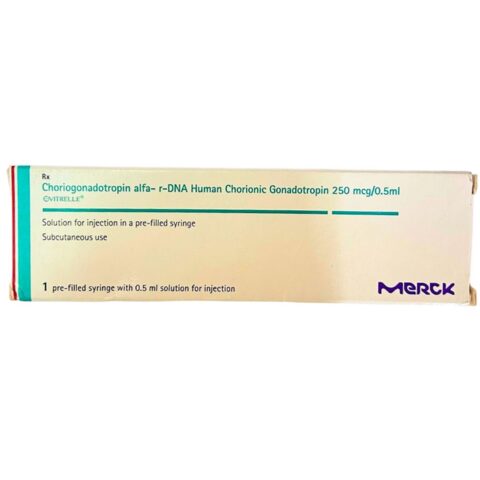
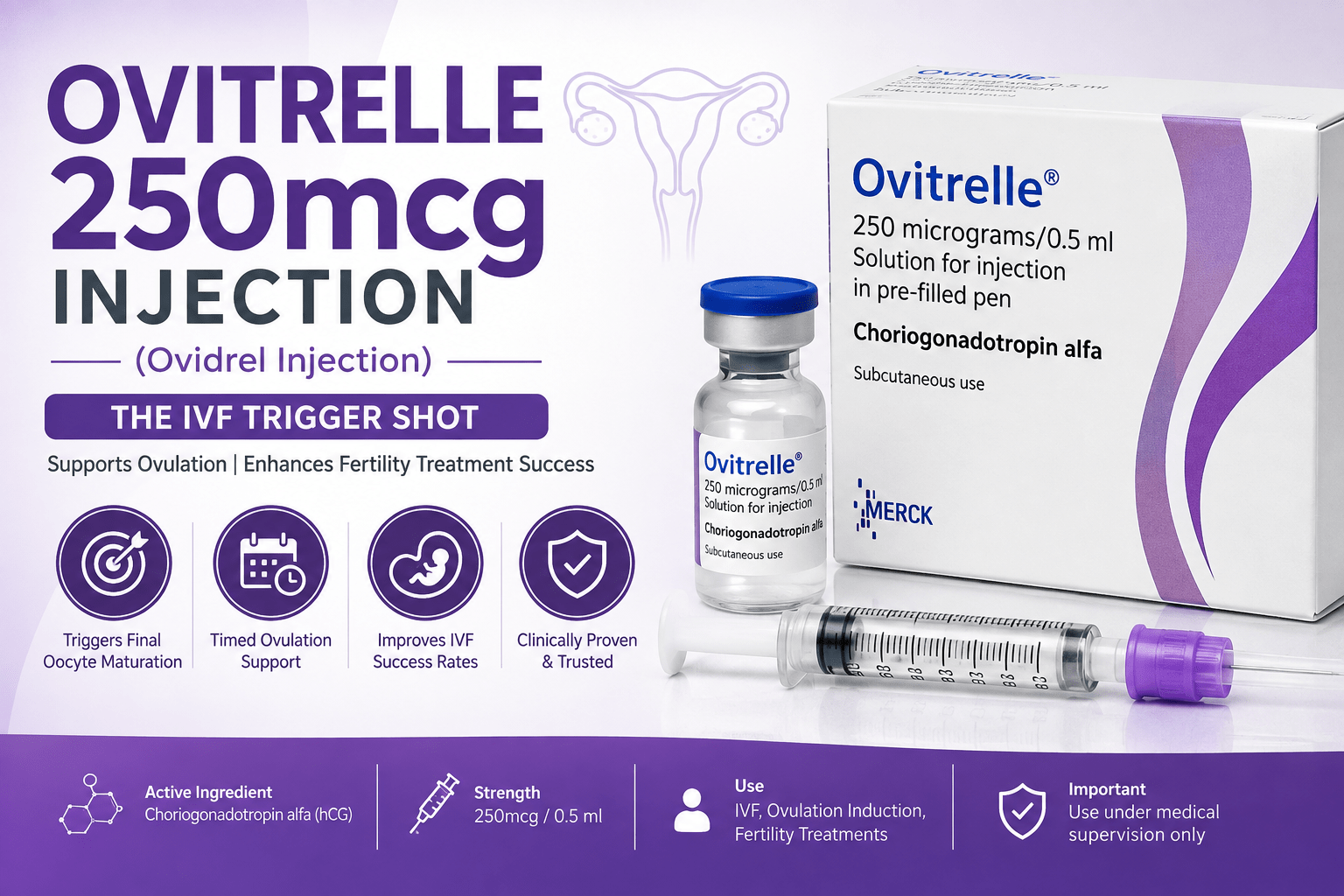
250 micrograms / 0.5 mL
Equivalent Activity
Approximately 6,500 IU
Route
Subcutaneous injection
Main Role
Ovulation / final follicular maturation trigger
Brand Names
Ovitrelle / Ovidrel
Prescription Status
Prescription fertility medicine
“`
Product presentations and approved indications can differ by country. Always follow the product information supplied in your country and the instructions of your fertility specialist.
Understanding the medicine
What Is Ovitrelle 250mcg Injection?
Ovitrelle 250mcg injection contains choriogonadotropin alfa, a recombinant form of human chorionic gonadotropin (hCG). It is administered by subcutaneous injection and is used as part of medically supervised fertility treatment.
Ovitrelle is primarily used after ovarian stimulation when follicles have developed sufficiently. The medication provides an hCG signal that acts similarly to the natural luteinising hormone (LH) surge involved in ovulation.
In assisted reproductive technology (ART), the purpose is generally to trigger final follicular maturation and luteinisation. In ovulation-induction treatment, the purpose is to trigger ovulation after appropriate follicular development.
Ovitrelle is commonly called a “trigger shot” because it provides the hormonal signal used to trigger the final stage of the ovulatory process after follicles have been stimulated and monitored.
Brand names
Ovitrelle vs Ovidrel: Are They the Same Medicine?
Patients searching online may encounter both Ovitrelle injection and Ovidrel injection. The names can be confusing because they are used in different markets.
A brand name for choriogonadotropin alfa used in markets including the European Union. Ovitrelle is available in presentations such as a 250 microgram pre-filled syringe or pen in relevant markets.
The US brand name for choriogonadotropin alfa. The US Ovidrel prefilled syringe delivers 250 micrograms of choriogonadotropin alfa in 0.5 mL.
Because medicines can have different approved indications, presentations, instructions and labeling in different countries, patients should compare the active ingredient, strength and local prescribing information rather than relying only on the brand name.
The science
How Does Ovitrelle Work?
Ovulation normally depends on a coordinated hormonal sequence involving follicle development, oestrogen production and an LH surge. The LH surge helps initiate the final maturation and rupture of the dominant follicle.
Choriogonadotropin alfa is a recombinant form of hCG and has activity at the LH/hCG receptor. By activating this receptor, it provides a hormonal signal that promotes late follicular maturation, resumption of oocyte meiosis and rupture of the pre-ovulatory follicle.
“`
Follicles are stimulated
Follicular development is monitored
Ovitrelle provides an hCG/LH-like signal
Final maturation and ovulatory process
“`
The important point is that Ovitrelle generally comes after follicular stimulation. It is not intended to replace the medicines used to stimulate follicle development. The decision to administer the trigger is based on monitoring and the treatment plan established by the fertility specialist.
Approved fertility uses
What Is Ovitrelle Injection Used For?
The approved use of Ovitrelle depends on the country, but the European product information identifies two major clinical situations in adult women: assisted reproductive technology such as IVF, and ovulation induction in anovulatory or oligo-ovulatory women after follicular stimulation.
| Fertility Treatment | Role of Ovitrelle | What Happens Before It? |
|---|---|---|
| IVF / ART | Triggers final follicular maturation and luteinisation | Ovarian stimulation and follicle monitoring |
| Ovulation induction | Triggers ovulation after appropriate follicular development | Medication used to stimulate follicular growth |
| Timed intercourse / monitored cycle | May be used as an ovulation trigger when clinically appropriate | Follicular development assessed by the fertility team |
Important: the exact fertility protocol is individualized. Ovitrelle should not be used simply because a person is trying to conceive; it is a prescription medicine used as part of a medically supervised fertility treatment plan.
Understanding the trigger
When Is the Ovitrelle 250mcg Injection Given?
Timing is one of the most important parts of fertility treatment. Ovitrelle is generally administered only after the fertility team has determined that follicular development is adequate.
European product information states that a 250 microgram pre-filled syringe is generally administered 24 to 48 hours after optimal follicular stimulation has been achieved. For IVF/ART, this is generally 24 to 48 hours after the last FSH or hMG administration. The US Ovidrel label describes administration one day after the final follicle-stimulating dose, after adequate follicular development has been demonstrated by monitoring.
The trigger time is calculated around follicle development and the planned fertility procedure. Taking Ovitrelle too early or too late can interfere with the treatment schedule. Use the exact date and time provided by your fertility clinic.
The 250 microgram dose
Ovitrelle 250mcg: What Does the Dose Mean?
The standard Ovitrelle pre-filled syringe contains 250 micrograms of choriogonadotropin alfa in 0.5 mL, equivalent to approximately 6,500 IU. European product information identifies 250 micrograms as the maximum dose for Ovitrelle.
“`
Active substance
Choriogonadotropin alfa
Dose
250 mcg
Volume
0.5 mL
Approx. activity
6,500 IU
“`
The dose should not be increased, repeated or changed without specific instructions from the fertility specialist. More hCG does not automatically mean a better chance of pregnancy, and excessive ovarian response can increase the risk of complications such as OHSS.
Administration
How Is Ovitrelle Injection Given?
Ovitrelle is administered subcutaneously, meaning the medicine is injected into the tissue beneath the skin rather than directly into a vein or muscle.
Patients may be trained to self-administer the injection. European product information specifically states that self-administration should only be performed by patients who have been adequately trained and have access to expert advice.
- Use the injection exactly at the time instructed by the fertility clinic.
- Use the supplied device according to its local patient instructions.
- Do not reuse a single-use syringe or injection materials.
- Dispose of needles and injection equipment safely according to local guidance.
- If you are unsure about the injection technique, contact the clinic rather than guessing.
Side effects
Ovitrelle Side Effects: What Can Happen?
Like all fertility medicines, Ovitrelle can cause side effects. Some symptoms are relatively mild, while others can signal an excessive ovarian response and require urgent medical assessment.
In clinical studies of Ovidrel 250 micrograms, reported adverse events included injection-site reactions, injection-site pain or bruising, abdominal pain, nausea and vomiting. The exact frequency can vary according to the treatment population and clinical setting.
- Injection-site pain
- Injection-site bruising or reaction
- Abdominal discomfort or pain
- Nausea
- Vomiting
- Ovarian enlargement or cyst-related symptoms
The complication every patient should know
Ovitrelle and Ovarian Hyperstimulation Syndrome (OHSS)
Ovarian hyperstimulation syndrome (OHSS) is one of the most important risks associated with gonadotropin-based fertility treatment. It occurs when the ovaries respond excessively to stimulation and can range from mild symptoms to a serious medical condition.
The US Ovidrel label warns that OHSS can develop rapidly and may involve significant fluid accumulation, ovarian enlargement, abdominal symptoms, breathing difficulties and thromboembolic complications. Pregnancy can make OHSS more severe or prolonged.
Contact your fertility clinic or seek urgent medical care if you develop severe abdominal or pelvic pain, rapidly increasing abdominal swelling, rapid weight gain, persistent vomiting, shortness of breath, markedly reduced urine output, or other symptoms that concern you after an hCG trigger injection.
Monitoring before the trigger is therefore important. Ovarian response may be assessed using transvaginal ultrasound together with serum estradiol measurements. If there is evidence of an excessive response, the hCG trigger may be withheld.
After the trigger shot
What Happens After Ovitrelle Injection?
What happens next depends on the fertility treatment being performed.
| Treatment | What the Trigger Is For | What Happens Next |
|---|---|---|
| Ovulation induction | Trigger ovulation | Timed intercourse or another planned fertility procedure |
| IUI cycle | Coordinate ovulation timing | IUI scheduled according to the clinic protocol |
| IVF / ART | Complete final follicular maturation before egg retrieval | Egg retrieval is scheduled according to the IVF protocol |
The exact interval between the trigger and the next procedure is protocol-specific. Patients should follow the precise timing supplied by their fertility clinic rather than using a generic internet schedule.
Pregnancy testing
Can Ovitrelle Cause a False Positive Pregnancy Test?
Yes. This is one of the most important practical points about Ovitrelle and Ovidrel.
Because choriogonadotropin alfa is an hCG medicine, the injected hormone can interfere with the interpretation of pregnancy tests. The US product labeling specifically warns that Ovidrel administration may interfere with pregnancy-test interpretation.
A positive pregnancy test shortly after an hCG trigger may reflect the medication rather than a newly established pregnancy. Your fertility clinic will tell you when to perform the pregnancy test and how the result should be interpreted.
Who should not receive it?
Ovitrelle Contraindications and Important Precautions
Ovitrelle is not appropriate for every patient. The exact contraindications depend on the applicable local product label, but European and US labeling identify several important situations in which treatment should not be used.
- Known hypersensitivity to hCG/choriogonadotropin alfa or an excipient
- Primary ovarian failure
- Pregnancy
- Unexplained ovarian enlargement or certain ovarian cysts
- Unexplained gynaecological bleeding
- Certain hormone-dependent reproductive cancers
- Certain pituitary or hypothalamic disorders
- Conditions in which an effective response cannot reasonably be achieved
The full contraindication list differs between regulatory labels. Your fertility specialist should review your medical history, ovarian reserve, hormone results and reproductive anatomy before starting a stimulation-and-trigger protocol.
Storage
How Should Ovitrelle Be Stored?
Storage instructions can differ by product presentation and country, so patients should follow the instructions on their specific package.
For example, European Ovitrelle patient information states that the medicine should generally be stored refrigerated at 2°C to 8°C and not frozen. The US Ovidrel label also specifies refrigerated storage before dispensing, with specific provisions for limited room-temperature storage.
Do not assume that storage instructions for Ovitrelle in one country apply to Ovidrel or another presentation. Check the carton, package leaflet and pharmacist instructions for the exact product you received.
Questions patients search for
Frequently Asked Questions About Ovitrelle 250mcg
Ovitrelle 250mcg is used as part of medically supervised fertility treatment to trigger final follicular maturation and ovulation. It is used in assisted reproductive technology protocols such as IVF and in appropriate anovulatory or oligo-ovulatory patients after follicular stimulation.
Ovitrelle and Ovidrel are brand names used in different markets for medicines containing the active ingredient choriogonadotropin alfa. Product presentations and approved labeling can vary by country, so the active ingredient and local product information should always be checked.
Yes. Ovitrelle contains recombinant human chorionic gonadotropin, specifically choriogonadotropin alfa. It acts at the LH/hCG receptor and is used to provide an LH-like hormonal signal during fertility treatment.
Yes. Ovitrelle is commonly referred to as an ovulation trigger or “trigger shot” because it provides the hormonal signal used to initiate the final stage of follicular maturation and ovulatory processes after appropriate ovarian stimulation.
Yes. Because Ovitrelle contains hCG, residual medication can interfere with pregnancy-test interpretation. Follow your fertility clinic’s recommended testing date rather than testing too early and interpreting the result yourself.
Reported adverse events include injection-site pain or reactions, abdominal pain, nausea and vomiting. Ovarian hyperstimulation is an important potential complication of fertility treatment and should be taken seriously if significant abdominal symptoms, rapid weight gain, breathing difficulty or reduced urination occur.
Some patients can self-administer Ovitrelle after appropriate training. It should only be self-administered when the fertility team has taught the patient how to use the specific device and has provided appropriate instructions.
No. Ovitrelle is used to trigger the ovulatory process or final follicular maturation, but it cannot guarantee ovulation, fertilisation, implantation or pregnancy. Fertility outcomes depend on many factors, including ovarian response, egg and sperm factors, timing and the specific treatment protocol.
The bigger picture
What Ovitrelle Represents in Fertility Treatment
Ovitrelle 250mcg is not the medicine that creates an entire IVF or ovulation-induction cycle. Its role is much more specific — and that is precisely why timing matters.
Fertility treatment often begins with controlled ovarian stimulation to encourage follicular development. Once monitoring shows that the follicles have reached an appropriate stage, choriogonadotropin alfa can provide the hormonal signal needed for final maturation and the next planned step of treatment.
“The trigger shot is one timed step inside a much larger fertility treatment plan.”
If you have been prescribed Ovitrelle or Ovidrel, the most useful things to understand are why it was prescribed, when your clinic wants you to take it, what procedure or timing follows the injection, and which symptoms require medical attention.
Ovitrelle 250mcg injection contains choriogonadotropin alfa, a recombinant hCG used as a fertility-treatment trigger. It is commonly used after ovarian stimulation to trigger final follicular maturation and ovulation-related processes. Ovidrel is the corresponding US brand name. Because timing and monitoring are central to safe fertility treatment, Ovitrelle should be used exactly according to the fertility specialist’s instructions.
This article is for informational purposes only and does not constitute medical advice.
Ovitrelle/Ovidrel is a prescription fertility medicine. Dosing, timing, monitoring and treatment decisions must be made by a qualified fertility specialist or other appropriate healthcare professional.
Product indications, contraindications, storage requirements, formulations and instructions may vary by country. Always consult the package leaflet and local prescribing information for the product you have been prescribed.
Information reviewed against regulatory product information available in 2026.
📢 Why do we show ads?
We work hard to keep the prices of products listed on our site
as low as possible, while continuing to provide a
quality service.
Running and maintaining the website, servers, database, and other
services comes with ongoing costs. Ads are one of the ways we help
cover these expenses.
Don’t worry — our ads are minimal and are designed
to have as little impact on your browsing experience as possible.
By allowing these small ads, you help us keep the website running,
maintain our services, and continue offering products at competitive prices.
Thank you for your support!