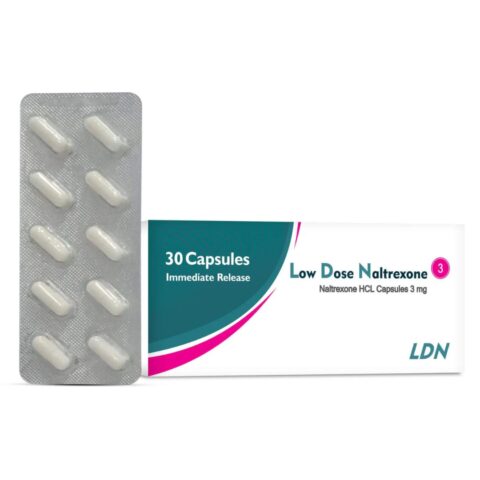
Naltrexone 3mg Capsules are an oral Low-Dose Naltrexone (LDN) formulation containing 3mg of naltrexone hydrochloride per capsule. LDN uses substantially lower doses of naltrexone than the conventional 50mg oral formulation. Low-dose naltrexone is prescribed off-label by some healthcare professionals for selected chronic pain, inflammatory, dermatologic and neuroimmune conditions.
Current literature describes LDN doses broadly in the range of approximately 0.5mg to 6mg, with 4.5mg being one of the most commonly studied doses; 3mg has also been used in clinical research and case reports. However, current evidence remains heterogeneous and does not establish LDN as a routine treatment for most proposed conditions.
Naltrexone 3mg is a low-dose formulation of naltrexone hydrochloride. The term LDN does not refer to a separate active pharmaceutical ingredient; it describes the use of naltrexone at doses considerably below the conventional doses used for its approved indications.
Naltrexone is an opioid receptor antagonist. At standard doses, naltrexone is used for specific approved indications, while lower-dose regimens are being investigated and used off-label for a range of conditions.
A 2026 narrative review identified 105 studies of low-dose naltrexone and reported that doses used in the literature generally ranged from 0.5mg to 6mg, while also concluding that the current evidence does not support routine clinical use across the broad range of proposed indications.
Both are considered LDN formulations, but the amount of naltrexone differs.
The appropriate dose is individualized. A 3mg capsule should not automatically be increased to 4.5mg or another strength without prescriber direction.
Naltrexone is primarily an opioid receptor antagonist. It binds to opioid receptors and blocks opioid activity.
The proposed mechanisms for LDN’s effects in chronic pain and inflammatory disorders extend beyond conventional opioid receptor blockade and remain an area of research. Proposed pathways include transient opioid-receptor blockade and effects on neuroimmune signaling and Toll-like receptor 4.
These mechanisms should be regarded as proposed pharmacological explanations rather than established proof of clinical effectiveness for every condition marketed with LDN.
Naltrexone 3mg for chronic pain is a commercially important LDN search term.
Low-dose naltrexone has been investigated for chronic pain and centralized pain conditions. However, evidence remains mixed. A 2025 meta-analysis of randomized trials found no significant overall difference between LDN and control groups for chronic pain, although a subgroup analysis suggested benefit in fibromyalgia.
Therefore, LDN 3mg should be positioned as an off-label treatment option under medical supervision, rather than as an established first-line pain medicine.
LDN for fibromyalgia is one of the most commercially searched applications of low-dose naltrexone.
Clinical studies and reviews have investigated LDN in fibromyalgia, with some evidence suggesting reductions in pain and symptom severity. However, the evidence is not yet sufficient to establish LDN as a universally recommended treatment.
A 2025 systematic review and meta-analysis reported improvements in pain and fibromyalgia symptom severity compared with baseline, while emphasizing the limitations of the available evidence.
LDN has also been investigated for neuropathic pain and other chronic pain syndromes.
Some clinical reports suggest potential benefit, but treatment response varies and the available evidence remains limited. LDN should therefore be prescribed according to the patient’s diagnosis and previous treatment response.
Low-dose naltrexone is also used off-label in some inflammatory and immune-mediated conditions.
Research has investigated LDN in areas including dermatologic disorders, chronic pain and neuroimmune conditions. A recent dermatology review described low-dose naltrexone use in conditions such as pruritus, psoriasis, lichen planus, hidradenitis suppurativa and other inflammatory dermatologic disorders, while noting that LDN is commonly compounded and that further research is needed.
LDN has been studied and prescribed off-label for selected dermatologic conditions.
Research includes conditions involving itch, inflammatory skin disease and immune-mediated dermatologic disorders. The evidence differs significantly between individual conditions and should not be generalized to all skin diseases.
For example, a randomized trial evaluated 3mg LDN in lichen planopilaris but did not demonstrate a statistically significant advantage over placebo when added to topical clobetasol.
LDN has attracted interest for symptoms associated with Long COVID.
A 2026 systematic review found observational evidence suggesting possible improvements in fatigue, cognition, sleep, pain and daily functioning, but no randomized controlled trials met the review’s inclusion criteria and the certainty of evidence was considered low.
Consequently, LDN should not be marketed as an established or approved treatment for Long COVID.
Naltrexone 3mg is a specific low-dose formulation. The appropriate LDN dose depends on the patient’s condition, treatment history, concurrent medications and prescriber’s clinical judgment.
Some LDN treatment protocols begin below 3mg and gradually increase the dose, while others use a fixed dose. There is no single standardized LDN dosing regimen applicable to every condition.
Do not change from 3mg to 4.5mg or another strength without medical guidance.
Possible adverse effects associated with naltrexone may include:
LDN is generally reported as reasonably well tolerated in published studies, but individual responses vary. Recent reviews also emphasize the need for better-quality studies to define optimal dose, duration and patient selection.
This is an important safety consideration with every naltrexone formulation, including LDN.
Naltrexone blocks opioid receptors and may interfere with opioid medicines. Patients using opioid painkillers, opioid-containing cough medicines or other opioid products must inform their healthcare professional before starting naltrexone.
Naltrexone can also precipitate opioid withdrawal in individuals who are physically dependent on opioids.
Do not attempt to overcome naltrexone’s opioid blockade by taking higher amounts of opioid medication.
Patients taking:
should discuss LDN with their healthcare professional before starting treatment.
Inform your doctor, dentist or surgeon that you are taking naltrexone before any procedure where opioid analgesia may be required.
Naltrexone is metabolized by the liver. Patients with liver disease or abnormal liver function should discuss their medical history with their healthcare professional before treatment.
Seek medical attention if symptoms such as yellowing of the skin or eyes, dark urine, persistent abdominal pain or unusual fatigue occur.
The conventional oral naltrexone 50mg formulation has an approved role in alcohol dependence treatment.
However, LDN 3mg should not be marketed as an equivalent 3mg treatment for alcohol dependence. The lower-dose LDN application is distinct from the established conventional-dose indication.
Naltrexone is sometimes searched online in connection with weight management.
However, Naltrexone 3mg alone is not an established FDA-approved weight-loss treatment. It should not be marketed as a standalone approved weight-loss medicine.
Naltrexone/bupropion is a separate combination medicine and should not be confused with LDN.
| Feature | Naltrexone 3mg LDN | Naltrexone 50mg |
|---|---|---|
| Strength | 3mg | 50mg |
| Category | Low-dose naltrexone | Conventional-dose naltrexone |
| Common formulation | Capsule/compounded formulation | Tablet |
| Typical use | Selected off-label applications | Approved indications vary by market |
| Common search term | LDN 3mg | Naltrexone 50mg |
| Opioid receptor activity | Yes | Yes |
The products contain the same active ingredient but are not interchangeable for every indication.
Naltrexone 3mg Capsules are commonly searched for as Low-Dose Naltrexone (LDN) 3mg, LDN Capsules, Naltrexone 3mg Capsules, Low-Dose Naltrexone Capsules and Naltrexone 3mg LDN.
Depending on the market, 3mg LDN may be supplied as a compounded prescription capsule. Product availability, compounding requirements, prescription regulations and import rules vary across the USA, UK, UAE/Dubai, Australia, Singapore, Thailand, China and Russia.
For commercial SEO, the strongest product-level intent should remain centered on:
Naltrexone 3mg Capsules → LDN 3mg → Low-Dose Naltrexone 3mg → LDN Capsules
Naltrexone 3mg is a low-dose formulation of naltrexone hydrochloride commonly referred to as Low-Dose Naltrexone (LDN).
LDN stands for Low-Dose Naltrexone. It describes naltrexone administered at substantially lower doses than conventional oral naltrexone.
Yes. A 3mg dose falls within the low-dose range described in the medical literature. A recent 2026 review identified LDN doses generally ranging from approximately 0.5mg to 6mg.
Naltrexone 3mg may be prescribed off-label for selected chronic pain, inflammatory, dermatologic or neuroimmune conditions. Evidence varies significantly by condition and does not establish LDN as a routine treatment for all of these conditions.
The 3mg LDN formulation and its off-label uses should not be represented as FDA-approved indications. Naltrexone has FDA-approved uses at conventional doses, while LDN is generally an off-label application.
They contain the same active ingredient, naltrexone hydrochloride, but the dose is substantially different and their clinical applications should not be treated as interchangeable.
LDN has been studied for fibromyalgia, including clinical trials and systematic reviews. Results are promising in some analyses but remain insufficient to establish LDN as a universally recommended treatment.
Yes, some clinicians prescribe LDN off-label for selected chronic pain conditions. Current evidence remains mixed and further high-quality research is needed.
LDN has been studied and prescribed off-label for selected dermatologic conditions, including some inflammatory and pruritic disorders. The evidence varies by condition.
Naltrexone can interfere with opioid medicines and may precipitate withdrawal in opioid-dependent individuals. Patients using opioids should discuss LDN with their healthcare professional before starting treatment.
Naltrexone is a prescription medicine, and LDN 3mg may require a compounded prescription depending on the market. Obtain it through an appropriately licensed pharmacy or authorized supplier.
Availability and compounding requirements vary by country. Regulations may differ across the USA, UK, UAE, Australia, Singapore, Thailand, China and Russia.
Medical Disclaimer: This product information is provided for educational and informational purposes only and is not a substitute for professional medical advice, diagnosis or treatment. Naltrexone 3mg/LDN is generally used off-label for conditions other than its established conventional-dose indications, and evidence varies substantially between conditions. Naltrexone can interfere with opioid medicines and may precipitate opioid withdrawal. Always disclose opioid use and relevant medical conditions to your healthcare professional before starting treatment. Do not start, stop or change LDN treatment without appropriate medical supervision.
Last Updated: August 24, 2026
Orders ship from our India Head Office within 1–2 business days of confirmation. We include full customs documentation — HS codes, certificates of origin, and pharmaceutical export permits.
Estimated delivery: 3–7 business days to UK. 7–10 business days to UAE, Saudi Arabia and Gulf countries. 10–15 days for USA and Asian countries.
All packages arrive in plain, unmarked brown boxes. No pharmacy name or medication details on the outside.
Only logged in customers who have purchased this product may leave a review.



Reviews
There are no reviews yet.