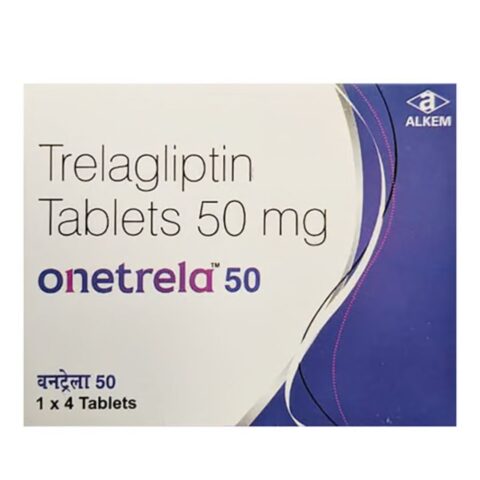
Trelagliptin 50mg Tablets are oral medicines containing trelagliptin succinate, a selective dipeptidyl peptidase-4 (DPP-4) inhibitor used in the management of type 2 diabetes mellitus in adults. Trelagliptin helps regulate blood glucose by inhibiting the DPP-4 enzyme, thereby prolonging the activity of incretin hormones involved in glucose-dependent insulin secretion.
Trelagliptin is notable for its once-weekly oral administration schedule, which distinguishes it from several other medicines in the DPP-4 inhibitor class that are taken daily. The active ingredient was developed in Japan and subsequently introduced in India, where trelagliptin tablets are marketed in 25mg, 50mg and 100mg strengths.
The 50mg strength is particularly relevant to dose adjustment in selected patients with moderate renal impairment. It should not be described as the universal starting dose for every adult. The usual adult dose in the referenced Indian product information is 100mg once weekly, while 50mg once weekly is specified for moderate renal impairment. The prescribed strength and schedule must be determined according to the patient’s kidney function, clinical circumstances and applicable prescribing information.
In India, the branded product Trelaglip 50 is marketed by Zuventus Healthcare. In Japan, Zafatek® 50mg is an established branded product containing trelagliptin succinate. Product registration, manufacturer, packaging and legal supply conditions vary by country.
| Detail | Information |
|---|---|
| Generic Name | Trelagliptin |
| Salt Form | Trelagliptin succinate |
| Indian Brand Reference | Trelaglip 50 |
| Japanese Brand Reference | Zafatek® 50mg |
| Strength | 50mg |
| Active Ingredient | Trelagliptin succinate equivalent to trelagliptin 50mg |
| Dosage Form | Film-Coated Tablet |
| Drug Class | Selective Dipeptidyl Peptidase-4 (DPP-4) Inhibitor |
| ATC Code | A10BH05 |
| Route | Oral |
| Indication | Type 2 diabetes mellitus in adults |
| Usual Adult Dose in Referenced Indian Product Information | 100mg once weekly |
| 50mg Dose Consideration | Reduced dose for moderate renal impairment under applicable labeling |
| Dosing Frequency | Once weekly when prescribed |
| Prescription Status | Subject to local prescription requirements |
| Pack Size | 4 tablets per Trelaglip wallet pack |
| Indian Manufacturer/Marketer | Zuventus Healthcare Limited |
| Japanese Product | Zafatek®; manufactured by Teijin Pharma Limited and marketed by Takeda Pharmaceutical Company |
| Indian Approval | Trelagliptin tablets approved for treatment of type 2 diabetes mellitus in December 2024 |
| Japanese Approval | Zafatek approved in Japan in March 2015 |
| Storage | Store below 30°C and protect from moisture according to the Trelaglip product information |
| Availability | Established products in India and Japan; verify authorization and supply status in other countries |
Trelagliptin is used for the treatment of type 2 diabetes mellitus in adults. It belongs to the DPP-4 inhibitor class of oral antidiabetic medicines and helps improve blood glucose regulation.
The 50mg formulation is a specific strength rather than a universal starting dose. Its appropriateness depends on the prescribing information and the patient’s medical circumstances, particularly renal function.
Type 2 Diabetes Mellitus
Type 2 diabetes is a chronic metabolic condition characterized by insulin resistance and, in many patients, insufficient insulin secretion to maintain normal blood glucose levels.
Trelagliptin inhibits the DPP-4 enzyme, which normally breaks down incretin hormones such as glucagon-like peptide-1 (GLP-1). By prolonging incretin activity, trelagliptin helps promote insulin secretion when blood glucose is elevated and supports the regulation of glucagon.
Treatment is used as part of a broader diabetes management plan that may include dietary management, physical activity, regular blood glucose monitoring and other prescribed antidiabetic medicines.
Clinical studies have evaluated trelagliptin as monotherapy and alongside other oral antidiabetic medicines. An Indian clinical study comparing trelagliptin 100mg once weekly with vildagliptin 50mg twice daily evaluated their effects on glycemic control in adults with type 2 diabetes. Clinical findings for a 100mg regimen should not be interpreted as evidence that every patient should take 50mg.
Trelagliptin 50mg may be considered in the following context:
Moderate renal impairment: A reduced dose is specified for selected patients under the applicable prescribing information.
Long-term diabetes management: Once-weekly administration may be part of the prescribed treatment plan.
Individualized dose selection: The treating clinician determines the strength and schedule based on renal function, glycemic control and other clinical factors.
When Is Trelagliptin 50mg Used Instead of 100mg?
Under the referenced Indian and Japanese product information, the dose may be adjusted according to renal function.
| Strength | Referenced Dosing Context | Important Consideration |
|---|---|---|
| 100mg | Usual adult dose | Once weekly when the standard dose is appropriate |
| 50mg | Moderate renal impairment | Reduced dose for the specified renal-function category |
| 25mg | Severe renal impairment or end-stage renal disease | Reduced dose under the referenced labeling |
For the referenced renal dosing guidance, 50mg once weekly is specified for moderate renal impairment with creatinine clearance from 30 to less than 50mL/min, while 25mg once weekly is specified for severe renal impairment with creatinine clearance below 30mL/min and end-stage renal disease.
These values describe the referenced product information and must not replace an individualized clinical assessment. Patients should not independently adjust their dose.
Who Should Not Use Trelagliptin for Self-Treatment?
Trelagliptin is not indicated for type 1 diabetes mellitus or diabetic ketoacidosis. The referenced Indian product information also lists severe ketosis, diabetic coma or precoma, severe infections, surgery, severe trauma and known hypersensitivity to the ingredients among contraindications or circumstances in which treatment should not be administered.
The applicable national product information must be consulted before treatment.
Trelagliptin has a glucose-regulating mechanism based on selective inhibition of dipeptidyl peptidase-4 (DPP-4).
1. DPP-4 Enzyme Inhibition
DPP-4 is an enzyme that breaks down incretin hormones, including glucagon-like peptide-1 (GLP-1) and glucose-dependent insulinotropic polypeptide (GIP).
Trelagliptin inhibits DPP-4, allowing incretin hormones to remain active for longer.
2. Increased Glucose-Dependent Insulin Secretion
Incretin hormones stimulate insulin secretion when blood glucose levels are elevated. By prolonging incretin activity, trelagliptin helps the pancreas release insulin in response to elevated blood glucose.
This mechanism supports glycemic control without acting as a direct replacement for insulin.
3. Regulation of Glucagon
Incretin activity also contributes to the regulation of glucagon, a hormone involved in releasing glucose into the bloodstream. This effect supports the body’s overall glucose-regulation process.
4. Sustained DPP-4 Inhibition
Trelagliptin has a prolonged pharmacological effect that permits once-weekly administration under the referenced prescribing information. Its weekly schedule distinguishes it from several other DPP-4 inhibitors that are usually administered daily.
Trelagliptin vs Other DPP-4 Inhibitors:
Trelagliptin, sitagliptin, vildagliptin, linagliptin and alogliptin belong to the DPP-4 inhibitor class. They differ in their dosing intervals, product formulations, renal considerations, clinical evidence and regulatory availability.
Trelagliptin’s once-weekly dosing schedule must not be applied to other medicines in the same class.
Trelagliptin is administered weekly rather than daily under the referenced product information. The dose must be selected according to the patient’s clinical circumstances and renal function.
| Renal Function / Clinical Situation | Referenced Dose | Condition / Consideration |
|---|---|---|
| Standard adult dosing when the usual dose is appropriate | 100mg once weekly | Usual adult dose in the referenced Indian product information |
| Moderate renal impairment, creatinine clearance 30 to less than 50mL/min | 50mg once weekly | Reduced dose under the applicable labeling |
| Severe renal impairment, creatinine clearance below 30mL/min | 25mg once weekly | Reduced dose under the referenced labeling |
| End-stage renal disease, including patients receiving hemodialysis | 25mg once weekly in the referenced labeling | Requires clinician supervision |
| Missed dose | Follow the patient leaflet and prescriber’s instructions | Do not double doses or change the weekly schedule independently |
Important dosing instructions:
Trelagliptin should be taken on the same day each week when prescribed.
The medicine is not intended to be taken as a daily tablet under the referenced dosing schedule.
The dose should be adjusted according to the applicable prescribing information when renal function is impaired.
Patients should not independently change their strength or dosing interval.
If a dose is missed, follow the instructions provided with the specific product and consult a healthcare professional when uncertain.
Trelagliptin’s prolonged action means that its effects and potential adverse reactions may continue after the last dose. Blood glucose levels and adverse effects should therefore be monitored according to the treating clinician’s instructions.
Important: This schedule summarizes the referenced Indian and Japanese product information. It is not an individualized dosing recommendation and must not replace a prescription.
Trelagliptin may be prescribed as part of a broader type 2 diabetes management plan when the treating clinician considers it appropriate.
Trelagliptin + Metformin: Metformin and trelagliptin act through different mechanisms involved in glucose regulation. Their combination may be considered by the treating clinician according to the applicable prescribing information and the patient’s clinical circumstances.
Trelagliptin + Sulfonylureas: Medicines such as glimepiride may be prescribed alongside trelagliptin in selected patients. However, the risk of hypoglycemia can increase, requiring appropriate monitoring.
Trelagliptin + Insulin: When trelagliptin is prescribed with insulin, glucose monitoring is particularly important because severe hypoglycemia may occur with combined glucose-lowering treatment.
Trelagliptin + Other Oral Antidiabetic Medicines: The suitability of combinations with additional diabetes medicines depends on the treatment plan, contraindications, safety considerations and local product information.
Combination Requiring Particular Caution:
Trelagliptin + insulin or sulfonylureas — increased concern about hypoglycemia, including severe episodes.
Trelagliptin + other glucose-lowering medicines — the overall treatment plan must be reviewed by the treating clinician.
Trelagliptin + GLP-1 receptor agonists — combination efficacy and safety have not been established in the referenced product information; do not combine without specialist direction.
Never add, remove or substitute an antidiabetic medicine without medical advice.
Zafatek® 50mg is an established Japanese branded product containing trelagliptin succinate. In India, Trelaglip 50 is marketed by Zuventus Healthcare.
Both brand references contain the same active ingredient at the 50mg strength. However, the term generic equivalent should only be used when the applicable regulatory status supports that claim in the specific target market.
Products containing trelagliptin may differ in their manufacturer, inactive ingredients, tablet appearance, packaging, approved indications and product-specific instructions.
Before switching between products, confirm the active ingredient, strength, dosing schedule, product authorization and prescribing instructions with the treating clinician or pharmacist.
Key distinctions:
Active Ingredient: Trelagliptin succinate, equivalent to the stated trelagliptin strength.
Strength: 50mg.
Indian Brand Reference: Trelaglip 50.
Japanese Brand Reference: Zafatek® 50mg.
Administration: Once weekly when prescribed.
Dose Selection: The 50mg strength is a reduced dose for specified renal impairment under applicable labeling; it is not the standard dose for every adult.
Market Authorization: A product’s authorization in India or Japan does not establish approval in the USA, UK, Australia, UAE or another country.
Manufacturer and Packaging: These depend on the specific product supplied.
Hypoglycemia — Low Blood Glucose
Trelagliptin may cause hypoglycemia, particularly when prescribed with insulin or sulfonylureas.
Monitor blood glucose as directed by the treating clinician.
Understand the symptoms and management of low blood glucose.
Seek medical advice if hypoglycemic episodes recur or become severe.
Follow the prescribed treatment plan when using other medicines that lower blood glucose.
Exercise caution when driving or operating machinery if symptoms of hypoglycemia occur.
Acute Pancreatitis
Acute pancreatitis has been reported in association with trelagliptin.
Persistent or severe abdominal pain, particularly when accompanied by vomiting, requires urgent medical assessment.
Seek medical attention promptly if symptoms suggest pancreatitis.
Follow the treating clinician’s instructions regarding further treatment and discontinuation.
Bowel Obstruction
Bowel obstruction is a reported serious adverse reaction.
Severe constipation, abdominal swelling, persistent abdominal pain or vomiting should not be ignored.
Seek urgent medical advice if these symptoms develop.
Patients with a history of abdominal surgery or intestinal obstruction require careful clinical consideration.
Pemphigoid and Skin Reactions
Pemphigoid, a condition involving skin blisters, has been reported. Other possible skin reactions include rash and itching.
Seek medical advice if new blisters, skin erosions or widespread skin reactions occur.
A significant skin reaction may require reassessment of treatment by a healthcare professional.
Renal Impairment
Reduced kidney function can delay the elimination of trelagliptin and increase drug exposure.
Kidney function should be assessed as clinically appropriate.
Dose adjustment may be required for moderate or severe renal impairment.
Do not assume that 50mg is the correct dose based on age or previous prescriptions alone.
Follow the product-specific instructions for severe renal impairment and end-stage renal disease.
Pregnancy and Breastfeeding
Trelagliptin should only be used during pregnancy when the potential therapeutic benefits are judged to outweigh the potential risks by the treating clinician. Animal studies have reported placental transfer of the medicine.
During breastfeeding, the benefits of treatment and breastfeeding should be considered by the healthcare professional. Animal studies have reported excretion of trelagliptin in breast milk.
Contraindications and Situations Requiring Medical Review
The referenced Indian product information lists the following:
Severe ketosis, diabetic coma or precoma.
Type 1 diabetes mellitus.
Severe infections, surgery or severe trauma.
Known hypersensitivity to trelagliptin or the product ingredients.
The applicable national product label may differ. The product information for the actual medicine supplied should always be consulted.
Drug Interactions and Combined Treatment
Insulin and sulfonylureas — increased risk of hypoglycemia.
Other antidiabetic medicines — assess the complete treatment regimen and monitoring requirements.
GLP-1 receptor agonists — combination efficacy and safety have not been established in the referenced product information.
Prescription medicines, over-the-counter products and supplements — disclose all medicines to the treating clinician or pharmacist.
Driving and Operating Machinery
Hypoglycemia may impair concentration and reaction time. Patients should follow medical advice before driving or operating machinery, particularly when trelagliptin is used with other glucose-lowering medicines.
Always read the patient information leaflet and prescribing information applicable to the country in which the medicine is supplied.
| Country | Status | Notes |
|---|---|---|
| USA | Local authorization not confirmed | Verify current FDA authorization and local availability before making a product-approval claim |
| UK | Local authorization not confirmed | Verify MHRA authorization and applicable prescribing requirements |
| Australia | Local registration not confirmed | Check the Australian Register of Therapeutic Goods before making availability claims |
| UAE / Dubai | Local registration not confirmed | Verify the applicable UAE medicine-registration requirements |
| India | Approved market | Trelagliptin tablets in 25mg, 50mg and 100mg strengths were approved for type 2 diabetes in December 2024; Trelaglip 50 is marketed by Zuventus |
| Japan | Approved market | Zafatek® is listed in the 25mg, 50mg and 100mg strengths |
| Germany | Local authorization not confirmed | Verify German and applicable EU authorization before describing the medicine as locally approved |
| France | Local authorization not confirmed | Check the applicable French authorization and supply status |
| Russia | Local registration not confirmed | Verify national authorization and prescription requirements |
| South Korea | Local registration not confirmed | Check MFDS registration before making approval claims |
| Worldwide | Varies by jurisdiction | Brand availability, regulatory status, prescription requirements and legal supply must be confirmed for each country |
This country table distinguishes established product markets from markets where authorization has not been confirmed. A product’s availability in India or Japan must not be interpreted as authorization for commercial supply in other countries.
What is Trelagliptin 50mg used for?
Trelagliptin is used for the treatment of type 2 diabetes mellitus in adults. It is a selective DPP-4 inhibitor that helps regulate blood glucose by prolonging incretin hormone activity. The 50mg strength is a specific prescribed dose, including for selected patients requiring renal dose adjustment under applicable product information.
Is Trelagliptin 50mg the same as Trelaglip 50?
Trelaglip 50 is an Indian branded product containing trelagliptin succinate equivalent to trelagliptin 50mg. Check the manufacturer’s information and packaging to confirm the product and strength.
Is Trelagliptin 50mg the generic for Zafatek® 50mg?
Trelagliptin is the active ingredient associated with Zafatek® in Japan. Trelaglip 50 is a marketed Indian product containing the same active ingredient at the 50mg strength. Whether a particular product legally qualifies as a generic equivalent depends on the relevant country’s regulatory status.
Is Trelagliptin 50mg the standard starting dose?
No. The usual adult dose in the referenced Indian product information is 100mg once weekly. The 50mg dose is specified for moderate renal impairment under the referenced labeling. The appropriate dose must be determined by the treating clinician.
How often should Trelagliptin 50mg be taken?
Trelagliptin is administered once weekly under the referenced product information. It is not intended to be taken as a daily tablet under that schedule. Patients should follow their individual prescription and the applicable patient leaflet.
What is the difference between Trelagliptin 25mg, 50mg and 100mg?
These are different strengths of the same active ingredient. The referenced product information lists 100mg once weekly as the usual adult dose, 50mg once weekly for moderate renal impairment and 25mg once weekly for severe renal impairment or end-stage renal disease. The correct dose depends on kidney function, clinical circumstances and the applicable product label.
Can Trelagliptin 50mg be taken with metformin?
Trelagliptin may be prescribed alongside other oral antidiabetic medicines, including metformin, when the treating clinician considers the combination appropriate. Do not independently add or substitute medicines. Blood glucose monitoring remains important.
Why must patients taking insulin or sulfonylureas be cautious?
Trelagliptin may increase the risk of hypoglycemia when combined with insulin or sulfonylureas. Severe low blood glucose has been reported with these combinations. The treating clinician may need to review the overall treatment plan and monitoring requirements.
What are the serious side effects of Trelagliptin 50mg?
Important reported risks include hypoglycemia, acute pancreatitis, bowel obstruction and pemphigoid. Seek urgent medical attention for severe or persistent abdominal pain, vomiting, serious low blood glucose or symptoms suggesting bowel obstruction or a significant skin reaction.
Is Trelagliptin 50mg suitable for people with kidney disease?
Renal impairment can increase trelagliptin exposure. The referenced product information includes reduced doses for moderate and severe renal impairment and end-stage renal disease. Patients with kidney disease require clinician-directed dose selection and monitoring.
Can Trelagliptin 50mg be taken every day?
No. Under the referenced product information, trelagliptin is administered once weekly. Patients should not convert the weekly schedule into daily administration or change the dose without medical advice.
Can I buy Trelagliptin 50mg tablets online?
Availability depends on the country, product authorization and applicable prescription requirements. Trelaglip 50 is a marketed product in India. Use an appropriately authorized pharmacy and a valid prescription wherever required. An online listing alone does not establish that a medicine can legally be supplied in your country.
Is Trelagliptin 50mg available in India and Japan?
Trelagliptin 50mg products are established in India and Japan. Trelaglip 50 is marketed by Zuventus Healthcare in India, while Zafatek® 50mg is listed in Japanese product information. Stock, packaging, manufacturer and dispensing requirements should be confirmed locally.
What is the brand name of Trelagliptin 50mg in India?
Trelaglip 50 is a branded Indian product marketed by Zuventus Healthcare. It contains trelagliptin succinate equivalent to trelagliptin 50mg per film-coated tablet.
How should Trelagliptin 50mg be stored?
The Trelaglip product information instructs storage below 30°C with protection from moisture. Always follow the storage instructions printed on the specific product packaging.
This information is provided for educational and product-reference purposes only. It is not a substitute for professional medical advice, diagnosis or treatment.
Trelagliptin 50mg is an antidiabetic medicine that must be used according to the applicable approved product information and the prescription of a qualified healthcare professional. The 50mg strength should not be interpreted as the standard starting dose for all adults. The usual adult dose in the referenced Indian product information is 100mg once weekly, while 50mg is specified for selected patients with moderate renal impairment.
Important risks include hypoglycemia, acute pancreatitis, bowel obstruction and skin reactions. Renal function, other diabetes medicines, pregnancy status and relevant medical conditions must be considered before and during treatment.
Always consult the prescribing clinician or pharmacist before starting, changing, discontinuing or substituting trelagliptin. Follow the laws, prescribing requirements and product information applicable to your country.
Last Updated: October 22, 2026
Orders ship from our India Head Office within 1–2 business days of confirmation. We include full customs documentation — HS codes, certificates of origin, and pharmaceutical export permits.
Estimated delivery: 3–7 business days to UK. 7–10 business days to UAE, Saudi Arabia and Gulf countries. 10–15 days for USA and Asian countries.
All packages arrive in plain, unmarked brown boxes. No pharmacy name or medication details on the outside.
Only logged in customers who have purchased this product may leave a review.


Reviews
There are no reviews yet.