
“`
Armodafinil and Excessive Daytime Sleepiness: When Being Tired Is More Than Being Tired
Why some people can sleep for hours and still struggle to stay awake — and where armodafinil fits into the treatment of certain sleep-wake disorders.
“`
Everyone knows what it feels like to have a bad night’s sleep.
You wake up tired. Coffee helps for a while. By afternoon, your concentration starts to disappear.
You tell yourself that tonight you’ll go to bed earlier.
But what happens when this isn’t an occasional problem?
What if someone sleeps what seems like a reasonable number of hours and still struggles to stay awake during meetings, work, study, commuting or everyday activities?
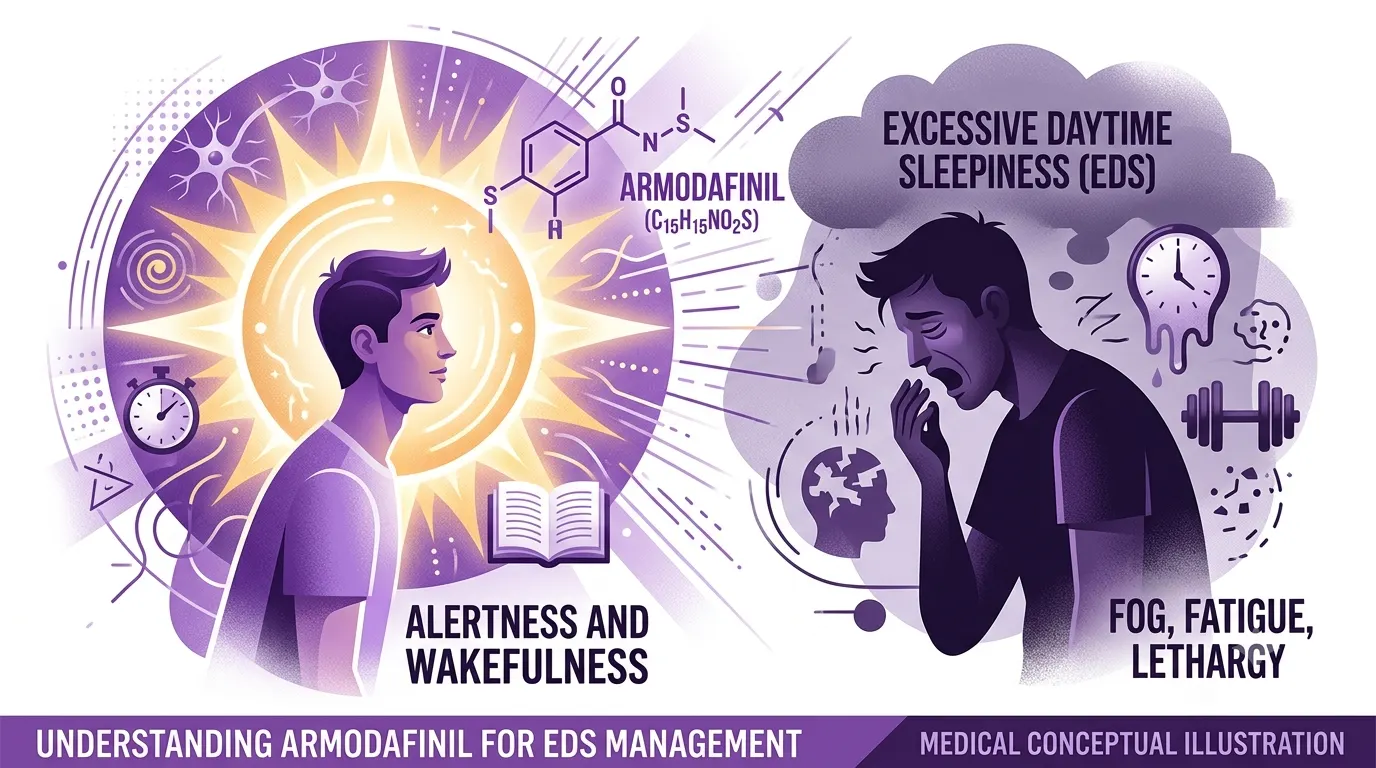
That’s where the conversation changes from ordinary tiredness to excessive daytime sleepiness (EDS).
In some people, it can be a symptom of an underlying sleep-wake disorder that deserves proper medical evaluation.
Armodafinil is one of the prescription medicines used to improve wakefulness in adults with excessive sleepiness associated with conditions including narcolepsy, obstructive sleep apnea and shift work disorder.
Armodafinil at a glance
Armodafinil
Wakefulness-promoting medicine
Narcolepsy, OSA-related sleepiness and shift work disorder
Oral tablets
50 mg, 150 mg and other strengths depending on market
Prescription medicine; regulations vary by country
Product strengths and approved uses can vary between countries. Always follow the prescribing information applicable to your market.
“I’m tired” and “I’m excessively sleepy” are not always the same thing
Fatigue and sleepiness are often used as if they mean exactly the same thing.
They don’t necessarily.
Fatigue can feel like a lack of physical or mental energy.
Sleepiness is more specifically the tendency to fall asleep or struggle to remain awake.
Someone can feel exhausted without actually falling asleep.
Another person may have a strong tendency to doze off even when they haven’t intended to sleep.
That distinction matters because persistent excessive sleepiness can occur with conditions such as narcolepsy, obstructive sleep apnea and shift work disorder.
Narcolepsy: when the brain struggles to regulate wakefulness
Narcolepsy is a neurological sleep disorder associated with excessive daytime sleepiness and abnormal regulation of sleep and wake states.
For someone with narcolepsy, daytime sleepiness can be far more disruptive than the normal tiredness most people experience after a late night.
It can interfere with work, studying, social activities and potentially safety-sensitive activities such as driving.
Armodafinil is one of the medicines that may be prescribed to improve wakefulness in adults with narcolepsy.
Sleep apnea can leave someone tired even after a full night in bed
Obstructive sleep apnea (OSA) is a condition in which breathing repeatedly becomes restricted or stops during sleep.
The result can be fragmented sleep and excessive daytime sleepiness.
This is important because armodafinil does not remove the underlying airway obstruction.
In people with OSA, armodafinil may be used to address persistent excessive sleepiness alongside treatment for the underlying breathing disorder.
Night shifts can challenge the body’s biological clock
Humans have an internal circadian rhythm that helps regulate when we feel awake and when we feel ready for sleep.
Night-shift work asks the body to do something fundamentally awkward: remain alert during a period when the biological clock is often promoting sleep, then sleep during daylight hours.
This mismatch can contribute to shift work disorder in some workers.
Armodafinil may be prescribed for excessive sleepiness associated with shift work disorder, with timing determined by the prescribed treatment plan.
Research has found that armodafinil can improve measures of wakefulness in people with excessive sleepiness associated with shift work disorder.
However, medication is only one part of managing a disrupted sleep schedule.
How does armodafinil promote wakefulness?
Here’s where things become interesting.
Armodafinil is the R-enantiomer of modafinil. It has pharmacological properties related to modafinil, but its exact mechanism for promoting wakefulness is not completely understood.
Official prescribing information describes effects involving the dopamine transporter and inhibition of dopamine reuptake, while also noting that the complete mechanism of wakefulness promotion remains unknown.
In other words, it would be an oversimplification to describe armodafinil as simply “a stronger stimulant.”
Its pharmacological profile is different from traditional sympathomimetic stimulants such as amphetamine and methylphenidate.
A better way to think about it:
Armodafinil is a wakefulness-promoting prescription medicine with a pharmacology distinct from conventional stimulant medications. Its clinical role is tied to specific sleep-wake disorders rather than ordinary tiredness.
Why 50 mg and 150 mg shouldn’t be viewed as “weak” versus “strong”
Armodafinil tablets are available in different strengths, and the right strength depends on the individual’s prescription and clinical situation.
A lower-strength tablet can be useful when a clinician needs a different dose or treatment strategy. A 150 mg tablet is another commonly used strength in clinical practice.
The important point is that patients should not choose a strength simply because a higher number sounds more effective.
Armodafinil 50 mg
A lower tablet strength that may be appropriate in specific prescribing situations.
Armodafinil 150 mg
A commonly referenced clinical strength, with dosing determined by the condition being treated and the prescriber’s instructions.
Do not increase, decrease or combine doses without medical advice. Product strengths and approved dosing can vary by country.
“`
The real question isn’t always “How do I stay awake?”
Modern life makes it tempting to treat sleepiness as an obstacle.
Long workdays. Night shifts. Screens late into the evening. Early commutes. International travel. Irregular schedules.
The temptation is to find something that keeps the brain switched on.
But persistent sleepiness can be useful information.
It may be telling you that your sleep quantity is insufficient. It may reflect poor sleep quality. It may be associated with sleep apnea, a circadian rhythm problem, narcolepsy, medication effects or another medical issue.
That is why the most useful conversation around wakefulness-promoting medicines starts with diagnosis rather than performance.
Don’t use wakefulness as a substitute for diagnosis.
If excessive sleepiness is persistent, discuss it with a healthcare professional rather than simply trying to override it with stimulants, caffeine or prescription medicines.
Armodafinil is not a harmless energy tablet
Armodafinil is a prescription medicine and can cause adverse effects.
Commonly reported effects include headache, nausea, dizziness and insomnia. Some people may also experience anxiety, dry mouth, decreased appetite or other effects.
More serious reactions can occur, including severe skin reactions, hypersensitivity reactions and psychiatric symptoms.
Armodafinil can also interact with other medicines. One particularly important consideration is hormonal contraception, because armodafinil can reduce the effectiveness of certain hormonal contraceptives.
Anyone considering armodafinil should tell their healthcare professional about prescription medicines, over-the-counter products and supplements they use.
Armodafinil isn’t a replacement for sleep
This deserves to be repeated.
Armodafinil can promote wakefulness, but it does not make sleep unnecessary.
If someone routinely sleeps too little and uses medication to push through the day, the underlying sleep deficit remains.
Even in people with diagnosed sleep disorders, treatment is about managing the condition — not eliminating the biological need for sleep.
A better long-term approach is to identify the reason for excessive sleepiness and address the cause wherever possible.
Want to understand the active ingredient?
Armodafinil is the active pharmaceutical ingredient responsible for the medicine’s wakefulness-promoting effect. If you want a more focused look at the ingredient itself, you can explore the dedicated armodafinil composition page.
Armodafinil questions people often ask
What is armodafinil?
Armodafinil is a prescription wakefulness-promoting medicine used to improve wakefulness in adults with excessive sleepiness associated with certain sleep-wake disorders.
Is armodafinil a stimulant?
Armodafinil promotes wakefulness, but its pharmacological profile is distinct from traditional sympathomimetic stimulants such as amphetamine and methylphenidate.
What is armodafinil 150 mg used for?
It is a commonly used tablet strength in the treatment of excessive sleepiness associated with certain conditions, but the appropriate dose depends on the individual prescription and clinical indication.
Is armodafinil the same as modafinil?
No. They are closely related medicines, but armodafinil is the R-enantiomer of modafinil and is a distinct prescription medicine.
Does armodafinil replace sleep?
No. It promotes wakefulness but does not replace the body’s need for adequate sleep.
Can armodafinil be used for ordinary tiredness?
Armodafinil is a prescription medicine for specific clinical conditions and should not be treated as a general-purpose remedy for everyday tiredness.
Sometimes sleepiness is a symptom, not a weakness.
Armodafinil has a legitimate role in improving wakefulness for adults with excessive sleepiness associated with conditions such as narcolepsy, obstructive sleep apnea and shift work disorder.
But the most useful approach to persistent daytime sleepiness is not simply finding a way to stay awake. It is understanding why the sleepiness is happening, treating the underlying problem where possible, and using medication only as directed by a qualified healthcare professional.
“`
Medical disclaimer: This article is for general educational purposes and is not medical advice, diagnosis or a substitute for professional treatment. Armodafinil is a prescription medicine. Indications, strengths, dosing recommendations and legal requirements may vary by country. Always follow the official product information and advice of your healthcare professional.
📢 Why do we show ads?
We work hard to keep the prices of products listed on our site
as low as possible, while continuing to provide a
quality service.
Running and maintaining the website, servers, database, and other
services comes with ongoing costs. Ads are one of the ways we help
cover these expenses.
Don’t worry — our ads are minimal and are designed
to have as little impact on your browsing experience as possible.
By allowing these small ads, you help us keep the website running,
maintain our services, and continue offering products at competitive prices.
Thank you for your support!