
Surgical Science · Hemostasis · Operating Room
Floseal 5ml Injection:
The Hemostatic Matrix That Stops Bleeding When Nothing Else Can
What it is, how it works, when surgeons use it — and why flowable hemostatic matrices have become essential tools in the modern operating room.
Informational guide · 6 minutes
Every surgeon knows the moment. The field is open, the procedure is going well — and then bleeding starts that won’t respond to pressure, cautery, or suture. In complex surgery, that moment happens more often than most people realise.
It’s in exactly that situation that advanced hemostatic agents earn their place in the operating room. Floseal 5ml Injection is one of the most widely used of them — a flowable hemostatic matrix that works with the body’s own clotting biology to stop bleeding fast, even in areas that conventional methods simply can’t reach.
This guide explains what Floseal is, the science behind how it works, and why it’s become a standard tool across surgical specialties worldwide.
Understanding the product
What Is Floseal 5ml Injection?
First, a clarification that matters: Floseal is not a patient injection in the conventional sense. It is a topical surgical hemostatic agent — applied directly by the surgeon to a bleeding site during an operation. It never enters the bloodstream.
It belongs to the flowable hemostatic matrix category — a class of advanced agents used when standard bleeding control methods such as sutures, electrocautery, or direct pressure have not been sufficient.
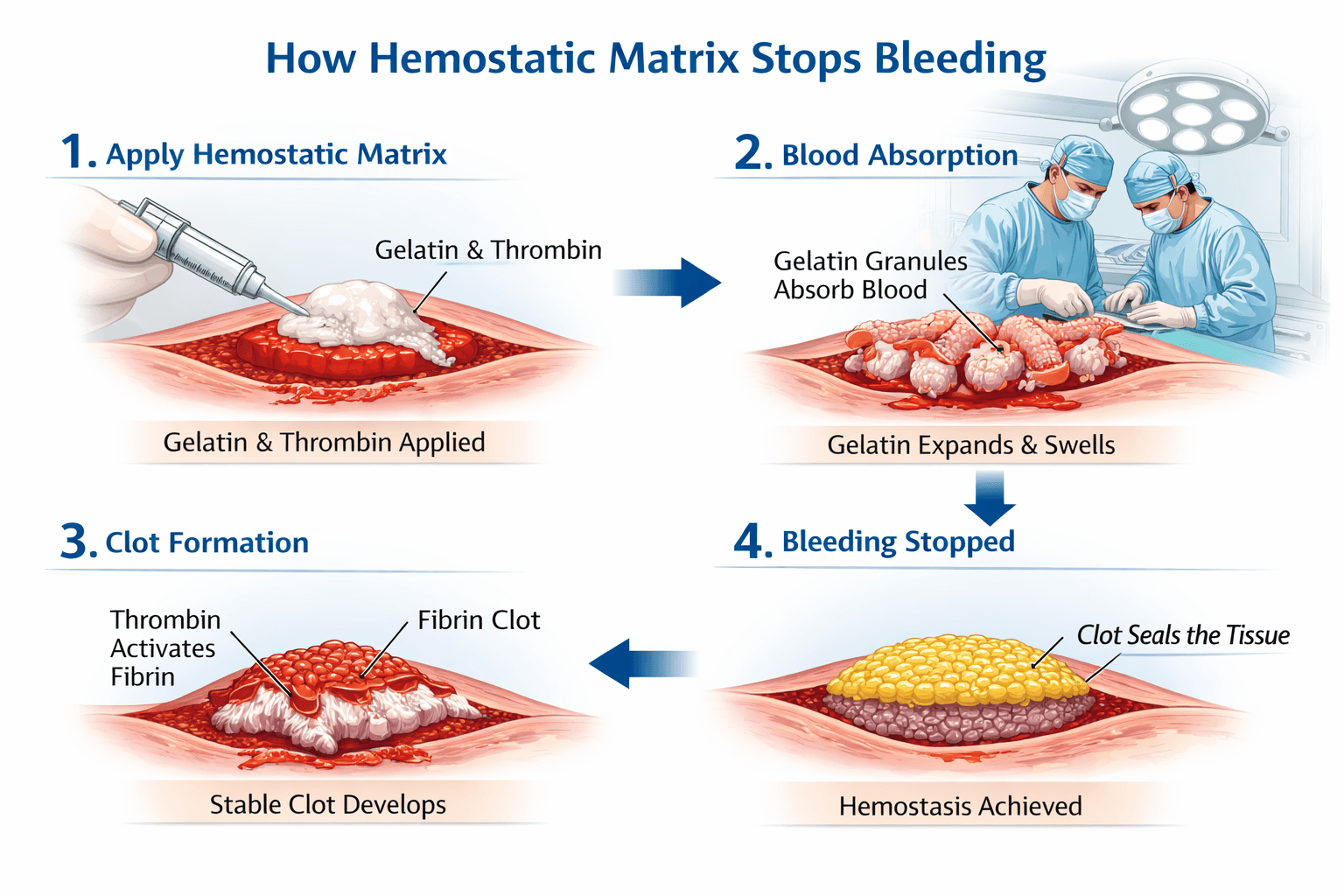
Floseal contains two active components: gelatin granules (a mechanical hemostat that absorbs blood and creates a physical barrier) and human thrombin (a biological agent that directly activates the clotting cascade). Together, they produce both mechanical and biological hemostasis simultaneously — which is what makes the combination so effective.
| Component | Type | Function | Role |
|---|---|---|---|
| Gelatin granules | Mechanical hemostat | Absorbs blood | Creates physical barrier |
| Human thrombin | Active hemostat | Converts fibrinogen to fibrin | Accelerates clot formation |
| Mixing solution | Diluent | Enables application | Ensures uniform spread |
The science
How Does Floseal Actually Work?
The mechanism is elegant — and it’s the reason flowable matrices outperform simpler hemostatic agents in complex surgical situations.
When Floseal is applied to a bleeding site, two processes happen in parallel:
The gelatin granules swell as they absorb blood, physically filling the wound space and creating a compressive mechanical barrier. This works immediately on contact.
The thrombin converts fibrinogen in the patient’s blood into fibrin — the structural protein that forms a stable clot. This accelerates the body’s own coagulation cascade significantly.
Step 1
Applied directly to the bleeding tissue — conforms to the shape of the surface, including irregular or difficult-to-reach areas.
Step 2
Gelatin granules absorb blood and begin swelling — creating immediate mechanical compression of the wound.
Step 3
Thrombin activates the clotting cascade — converting the patient’s own fibrinogen to fibrin and rapidly forming a stable biological clot.
Step 4
The expanded matrix holds the clot in place, maintaining hemostasis even under surgical conditions.
Result
Bleeding controlled. Surgical field cleared. Procedure continues.
“Because the matrix conforms to irregular tissue surfaces, it works in places where sutures and clips simply aren’t viable — that’s what separates it from conventional hemostatic approaches.”
Where it’s used
Which Surgical Specialties Use Floseal?
The breadth of Floseal’s application across surgical specialties reflects both its versatility and the universal challenge of surgical bleeding. It is used wherever bleeding is difficult to control through conventional means:
| Surgical Specialty | Why Hemostatic Matrix Is Needed |
|---|---|
| Cardiac Surgery | High intrinsic bleeding risk; anticoagulation during bypass |
| Spine Surgery | Limited surgical access; bleeding from bone surfaces |
| Orthopaedic Surgery | Bone is highly vascular; difficult to suture |
| Neurosurgery | Extremely delicate tissue; cautery risk to adjacent structures |
| ENT Surgery | Small vessels in confined spaces; difficult clip placement |
| Liver Surgery | Extremely dense blood supply; resection surfaces bleed heavily |
| Gynaecological Surgery | Soft tissue bleeding; minimally invasive surgical settings |
Context
How Does It Compare to Other Hemostatic Methods?
Floseal doesn’t replace conventional methods — it complements them. It’s the option surgeons reach for when the standard toolkit isn’t enough.
| Method | Speed | Works in Complex Anatomy | Precision |
|---|---|---|---|
| Sutures | Medium | Limited | High |
| Direct pressure | Slow | No | Low |
| Electrocautery | Fast | Limited | Medium |
| Clips | Medium | Limited | High |
| Floseal matrix | Fast | Yes | Very high |
Safety information
Important Precautions
Floseal is a hospital-only, operating-room product used exclusively by trained surgical professionals. Several precautions define its correct use:
- Never injected into blood vessels — topical use only, applied to the surface of bleeding tissue
- Excess material should be removed after hemostasis is achieved
- The matrix swells on contact with blood — this must be accounted for in confined anatomical spaces
- Only used in the presence of active bleeding — not for prophylactic application
- Hospital and operating room use only — not available or appropriate outside clinical settings
Why it matters
What Advanced Hemostasis Means for Surgical Outcomes
Bleeding control isn’t a marginal concern in surgery — it’s central to every outcome metric that matters. Reduced blood loss means reduced transfusion requirement. Better surgical visibility means fewer errors and shorter operating time. Faster hemostasis means safer procedures in high-risk patients.
Flowable hemostatic matrices like Floseal represent a meaningful step forward from the gauze-and-pressure era of surgical bleeding control. Their ability to work on irregular tissue surfaces, in confined spaces, and on both soft tissue and bone makes them genuinely versatile tools — not niche products for edge cases.
“Advanced hemostatic agents don’t just stop bleeding faster — they make operations safer, shorter, and more precise. That translates directly into better outcomes for patients.”
Understanding how products like Floseal work helps patients, medical students, and healthcare professionals alike appreciate the technology that makes modern complex surgery possible.
This article is for informational and educational purposes only.
Floseal is a prescription surgical product used exclusively by trained medical professionals in hospital and operating room settings.
It is not available for patient self-administration. Always refer to the product’s official prescribing information for clinical guidance.