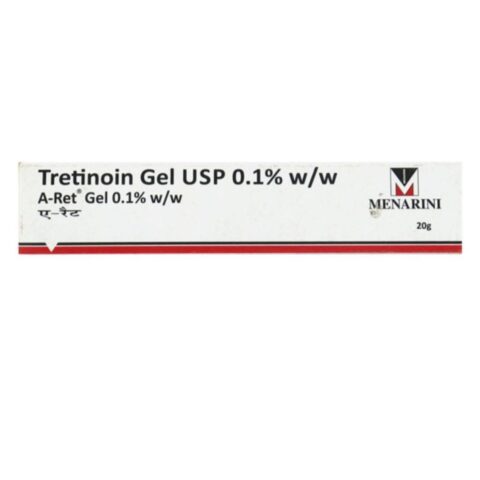
Drug: Tretinoin (All-Trans Retinoic Acid) | Class: Topical Retinoid — High Strength | Brand: Retin-A 0.1% Gel (Janssen); A RET 0.1% (Menarini) | Indication: Severe acne, photoaging, facial wrinkles, hyperpigmentation — highest strength topical retinoid | Dose: Apply pea-sized amount to entire face every other night initially
Tretinoin 0.1% gel is the highest commercially available strength of topical tretinoin (Retin-A), used for severe acne that has not responded to lower concentrations, or for accelerated treatment of photoaging, fine wrinkles, and hyperpigmentation. At 0.1%, it is significantly more active than 0.025% or 0.05% but causes more initial irritation — redness, peeling, and increased sensitivity (the ‘retinisation’ period). Starting every-other-night and building frequency over weeks minimises this initial reaction.
Tretinoin Gel 0.1%-20g contains Tretinoin (All-Trans Retinoic Acid), a topical retinoid — high strength for severe acne, photoaging, facial wrinkles, hyperpigmentation — highest strength topical retinoid. FDA-approved for acne and photoaging; Cochrane review: tretinoin improves photoaging measures vs vehicle at 24 weeks; meta-analysis: tretinoin 0.025–0.1% superior to vehicle for acne.
| Attribute | Details |
|---|---|
| Generic Name | Tretinoin (All-Trans Retinoic Acid) |
| Drug Class | Topical Retinoid — High Strength |
| Brand Reference | Retin-A 0.1% Gel (Janssen); Tretino-H 0.1% (Zydus India) |
| Indication | Severe acne, photoaging, facial wrinkles, hyperpigmentation — highest strength topical retinoid |
| Standard Dose | Apply pea-sized amount to entire face every other night initially. Increase to nightly after 2–4 weeks if tolerated. Use with moisturiser and SPF 30+ daily |
| Form | Topical Gel |
| Route | Topical |
| Prescription | Yes |
| Evidence | FDA-approved for acne and photoaging; Cochrane review: tretinoin improves photoaging measures vs vehicle at 24 weeks; meta-analysis: tretinoin 0.025–0.1% superior to vehicle for acne |
Binds nuclear retinoic acid receptors (RAR) normalising follicular keratinocyte differentiation, reducing comedone formation, stimulating collagen synthesis, and inhibiting matrix metalloproteinases that break down dermal collagen.
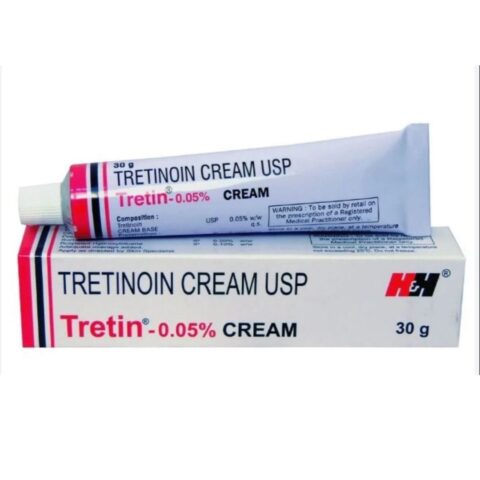
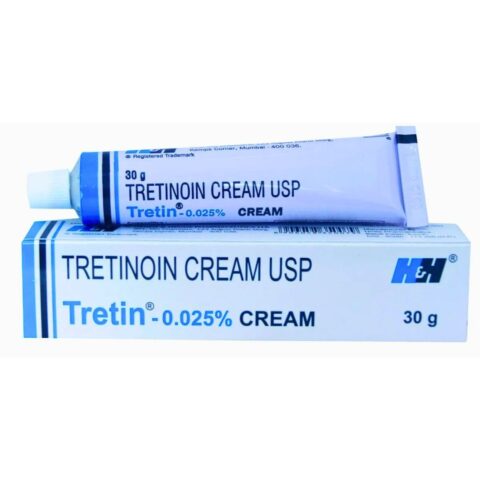
All three are the same active molecule (tretinoin); only the concentration differs. 0.025% is the gentlest — first-line for sensitive skin or those new to retinoids. 0.05% is the intermediate strength for established users. 0.1% is the most potent — maximum efficacy for acne and photoaging with the most initial irritation. Dermatologists typically start at 0.025% and titrate up over months based on tolerance and response.
Tretinoin gel is better for oily/acne-prone skin — the base dries on application without adding oils. Tretinoin cream is better for dry or sensitive skin — the cream base adds hydration alongside the retinoid. The active ingredient is the same; choice depends on skin type and tolerability. The 0.1% gel is particularly favoured for oily, acne-prone skin.
Initial skin texture improvement in acne occurs within 4–6 weeks. Significant comedone clearance: 8–12 weeks. Full acne benefit: 3–6 months. For photoaging (wrinkles, hyperpigmentation), significant improvement requires 6–12 months of consistent use. Tretinoin is a long-term treatment — short courses do not realise its full benefit.
Yes — apply a pea-sized amount to the entire face, not just individual spots. Tretinoin is a prophylactic treatment for all follicles, not a spot treatment. Spot application misses uninvolved follicles that will later develop comedones. Apply to clean, completely dry skin (wait 20–30 minutes after washing) — moisture on the skin increases irritation.
Vitamin C (ascorbic acid) serum and tretinoin are an evidence-based combination for photoaging — vitamin C brightens hyperpigmentation and provides antioxidant protection; tretinoin stimulates collagen. Use vitamin C in the morning; tretinoin at night. Both are photosensitisers — daily SPF 50+ sunscreen is non-negotiable when using this combination.
Store at 15–30°C away from sunlight and moisture. Keep out of reach of children.
Orders ship from our India Head Office within 1–2 business days of confirmation. We include full customs documentation — HS codes, certificates of origin, and pharmaceutical export permits.
Estimated delivery: 3–7 business days to UK. 7–10 business days to UAE, Saudi Arabia and Gulf countries. 10–15 days for USA and Asian countries.
All packages arrive in plain, unmarked brown boxes. No pharmacy name or medication details on the outside.
Only logged in customers who have purchased this product may leave a review.

Reviews
There are no reviews yet.