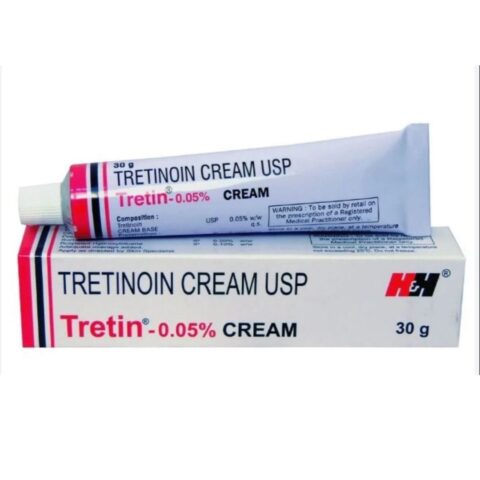
Drug: Tretinoin | Class: Topical Retinoid — Intermediate Strength | Brand: Retin-A 0.05% Cream (Janssen); Tretin 0.05% (H&H Pharma) | Indication: Moderate acne, photoaging, fine wrinkles, hyperpigmentation, melasma — intermediate retinoid strength | Dose: Apply pea-sized amount nightly
Tretinoin 0.05% cream is the most widely studied and prescribed strength for photoaging and moderate acne. It provides meaningful clinical benefit (wrinkle reduction, hyperpigmentation fading, acne control) with better tolerability than the 0.1% strength. It is the preferred concentration for most adults starting retinoid therapy for anti-aging, and for patients who have built tolerance to 0.025% and are stepping up. The cream base makes it well-suited for normal-to-dry skin types.
Tretinoin Cream 0.05%-30g contains Tretinoin, a topical retinoid — intermediate strength for moderate acne, photoaging, fine wrinkles, hyperpigmentation, melasma — intermediate retinoid strength. FDA-approved; Cochrane confirmed efficacy for photoaging at 0.05%; most-studied retinoid concentration for photoaging.
| Attribute | Details |
|---|---|
| Generic Name | Tretinoin |
| Drug Class | Topical Retinoid — Intermediate Strength |
| Brand Reference | Retin-A 0.05% Cream (Janssen); Tretino 0.05% (Zydus India) |
| Indication | Moderate acne, photoaging, fine wrinkles, hyperpigmentation, melasma — intermediate retinoid strength |
| Standard Dose | Apply pea-sized amount nightly. May start every other night and increase to nightly after 2–4 weeks. Use with SPF 30+ daily |
| Form | Topical Cream |
| Route | Topical |
| Prescription | Yes |
| Evidence | FDA-approved; Cochrane confirmed efficacy for photoaging at 0.05%; most-studied retinoid concentration for photoaging |
RAR nuclear receptor binding normalising keratinocyte differentiation, reducing comedone formation, stimulating collagen production.
For anti-aging (photoaging), cream formulations at 0.05% are generally preferred — the cream base adds hydration alongside the retinoid effect, reducing the dryness that makes anti-aging use uncomfortable. Gel formulations suit oily/acne-prone skin. For most patients using tretinoin primarily for anti-aging, the 0.05% cream formulation is the standard.
Retinisation is the skin adjustment period (weeks 1–8) when starting tretinoin — characterised by dryness, peeling, redness, and increased sensitivity. It is more pronounced at 0.05% than 0.025%. Strategies: start every other night; use a gentle moisturiser 30 minutes before applying tretinoin (‘sandwich method’); avoid other actives (acids, vitamin C) until skin adjusts. The irritation subsides as skin adapts.
No — all tretinoin formulations (topical and oral) are contraindicated in pregnancy. Topical tretinoin has minimal systemic absorption, but animal studies show teratogenicity and the precautionary principle applies. Women planning pregnancy should stop tretinoin before conception. Azelaic acid is a safe alternative for acne and hyperpigmentation during pregnancy.
Cleanse, wait for skin to dry completely (20–30 minutes). Apply a pea-sized amount of tretinoin 0.05% to face, avoiding eyes and lips. Moisturise over or after if needed. Apply only at night. Use SPF 30–50+ every morning without fail. In the first 2 weeks, use every other night; increase to nightly as tolerance develops.
The opposite — tretinoin thickens the epidermis and dermis over time by stimulating collagen production and reducing collagen degradation. This is the mechanism of its anti-aging effects. Initial peeling may feel like thinning, but this is surface cell turnover acceleration, not atrophy. Topical retinoids are not corticosteroids — they do not cause skin atrophy.
Store at 15–30°C away from sunlight and moisture. Keep out of reach of children.
Orders ship from our India Head Office within 1–2 business days of confirmation. We include full customs documentation — HS codes, certificates of origin, and pharmaceutical export permits.
Estimated delivery: 3–7 business days to UK. 7–10 business days to UAE, Saudi Arabia and Gulf countries. 10–15 days for USA and Asian countries.
All packages arrive in plain, unmarked brown boxes. No pharmacy name or medication details on the outside.
Only logged in customers who have purchased this product may leave a review.

Reviews
There are no reviews yet.